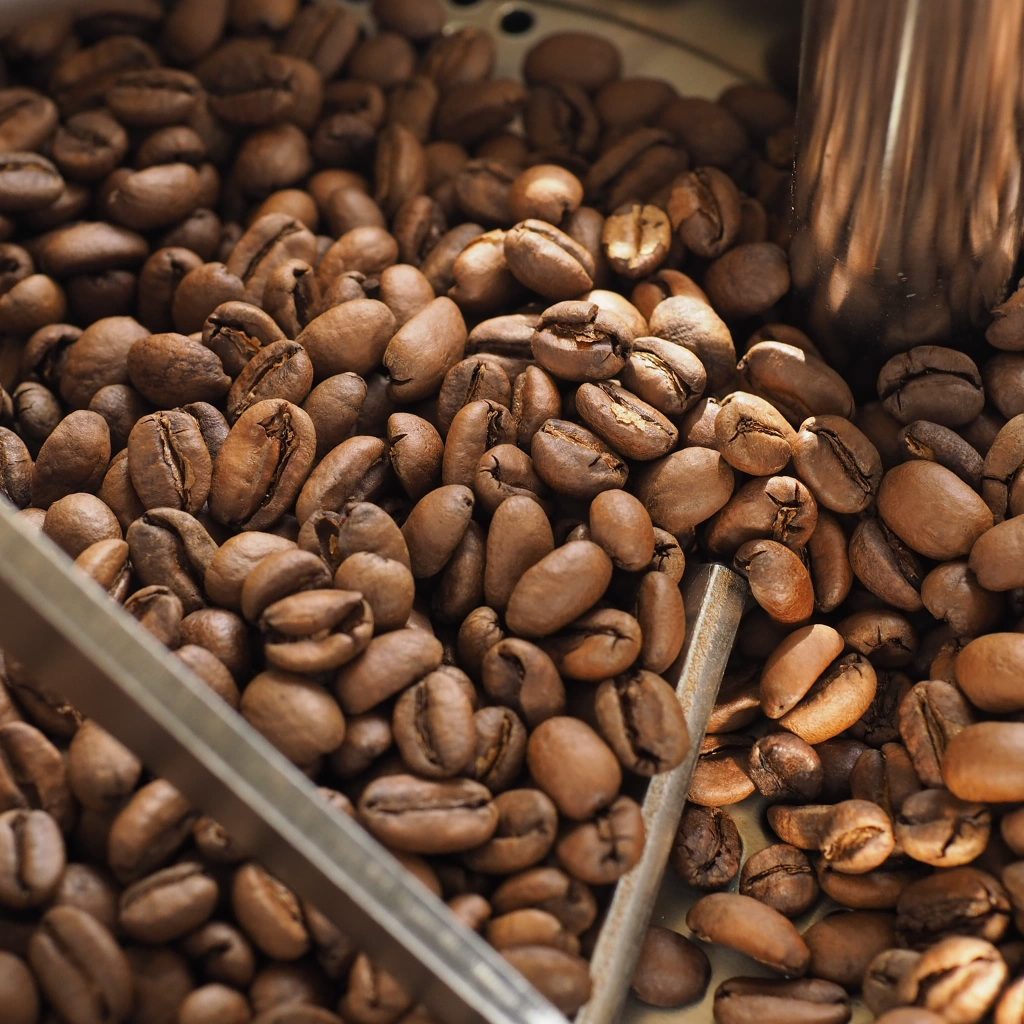
Cooling is the final step of coffee roasting, and it plays an important role in determining the final result. When coffee leaves the roaster, the beans still retain a considerable amount of thermal energy. If this heat is not removed quickly, thermal progression may continue after drop, causing the final roast degree to become darker than intended.
At the same time, prolonged exposure to high temperatures may accelerate the loss of volatile aroma compounds, including some of the floral, fruity, and other delicate aromas we want to preserve.
mins
Reading Time
Why Coffee Roasting Does Not Stop Immediately at Drop
The end temperature of a roast is typically over 200°C.
When coffee is dropped from the roaster, the main external heat source is removed, but the beans themselves are still at a very high temperature and retain a considerable amount of thermal energy. Heat continues to move within the beans and from the beans into the surrounding environment. In this sense, drop is a clear operational endpoint for the roaster, but it is not an instantaneous thermal endpoint for the coffee.
As long as the beans remain sufficiently hot, some of the physical and chemical processes associated with roasting can continue. Baggenstoss et al. noted that rapid cooling is necessary to avoid overroasting and to stop exothermic reactions within roasted coffee beans. Earlier research cited in their study also suggested that exothermic reactions may continue during the first seconds of air cooling.
For this reason, cooling should be considered the final part of controlling the roast rather than simply something that happens after roasting. Its purpose is to remove the remaining heat quickly enough to prevent the coffee from continuing to develop significantly beyond the roast degree intended at drop.
What Experiments Tell Us About Coffee Cooling Speed
Forced-Air Cooling vs. Passive Cooling
Baggenstoss et al. conducted a useful experiment comparing different cooling methods. They used a laboratory-scale fluidized-bed roaster, roasting 200 g of coffee per batch under the same roasting conditions before applying different cooling methods.
Experimental Methods
For forced-air cooling, ambient air was passed through the coffee at 1.4 m³/min for 4 minutes. In another group, the freshly roasted coffee was placed in a wide steel container and allowed to cool naturally at room temperature without any forced airflow. This group took approximately 45 minutes to cool.
The two groups showed measurable differences. The naturally cooled coffee was slightly darker, which the researchers attributed to the slower decrease in temperature, resulting in a slightly higher final degree of roast compared with the other cooling methods.
What this study tells us is that cooling speed can affect the final degree of roast. When heat is removed significantly more slowly, the coffee may continue to develop during cooling, even to the point where the difference can be detected through final color measurements.
This result is important because it shows that removing coffee from the roaster does not mean that thermal progression stops immediately. If the remaining heat inside the beans is removed too slowly, the coffee may continue to develop during cooling, altering the roast degree that was intended at drop.
A darker roast has a higher end temperature. Its terroir expression is weaker compared with a light roast, and its floral and fruity aromas are less obvious.
It is easy to understand that as temperature rises and the roast becomes darker, the color of the coffee beans generally becomes darker as well. However, color is only one part of the result. More importantly, as roasting continues, the chemical composition inside the beans and the final flavor continue to change.
I don’t think the colors (spread) of a bean can fully represent the cup.
This is because the amount and composition of chemical compounds and moisture involved in the reactions, as well as the way heat is transferred through the beans, may not be exactly the same in every roast. Therefore, even when the final roast color is similar, the flavor in the cup may still be different.
In other words, roast color can help us describe the degree of roast, but it cannot fully represent the flavor of the coffee on its own.
How Continued Heat After Drop Can Affect Coffee Flavor and Aroma
As the roast approaches its end, the coffee beans are still at a very high temperature, and many thermal reactions are progressing rapidly. Especially during the later part of development, even a difference of just a few seconds can noticeably affect the final flavor.
As the degree of roast increases, the coffee’s more delicate floral, fruity, and origin characteristics generally become less pronounced, while caramel, nutty, roasted, and other roast-derived flavors become more noticeable.
Therefore, dropping the coffee does not mean these changes stop chemically in an instant. If a considerable amount of heat remains inside the beans and the temperature decreases too slowly, roast-related thermal reactions may continue during cooling, allowing the coffee to progress toward a darker roast degree.
This is especially important for coffees roasted lightly to preserve floral, fruity, and origin characteristics. For example, with many Ethiopian coffees, if the remaining heat is not removed quickly after reaching the intended roast degree and dropping the coffee, some of the delicate flavors we want to preserve may be affected by continued thermal progression.
This is why cooling should not simply be viewed as the process of bringing coffee down to room temperature after roasting. It should be considered the final and indispensable step in coffee roasting.
[…] and with this new cooling tray, the beans are cooled very quick and also speeds up my roasting process. The result is enhanced bean characteristic notes and less baked flavor. Virtually no chaff is also a bonus as I’m selling my coffee.
Therefore, one of the most important purposes of rapid cooling is to preserve the roast decision made at drop. Once the coffee has reached the intended roast degree, the remaining heat should be removed efficiently rather than allowing the beans to continue developing in the cooling tray and move away from the intended roast degree.
How Fast Should Coffee Be Cooled After Roasting?
In general, coffee should be cooled as quickly as possible after drop. A common recommendation is to bring the beans close to room temperature within a few minutes. In practice, cooling speed is mainly affected by several factors, including cooling airflow, ambient temperature, and batch size.
Based on my own experience, ambient temperature has a significant effect on cooling. In Taiwan, even with air conditioning in the roasting room, the room temperature can still easily exceed 30°C during summer. Under these conditions, if the cooling fan does not have enough capacity, it can be difficult to cool every batch quickly and consistently. I also do not want to spend a long time waiting for the coffee to cool after every roast.
I have also tried continuously stirring the beans with a large spoon, but I found the improvement to be limited. Stirring can help the beans contact the surrounding air more evenly, but without enough airflow to continuously carry the heat away, the cooling rate is still limited.
For this reason, I needed a cooling tray with greater cooling capacity. At the time, I asked my father, a mechanic with nearly 50 years of experience, to help me build a cooling system. Since then, I no longer have to worry about cooling speed becoming a factor that affects coffee quality, and the overall roasting workflow has become much more efficient.
If your roasting environment changes significantly with the seasons, a cooling system with sufficient capacity can help maintain more consistent cooling performance from batch to batch throughout the year.
Cooling Performance: Speed, Capacity, and Ambient Temperature
The R1 has now been completely discontinued, and Aillio’s current models are the R2 and R2 Pro. The R2 Pro cooling tray features an automatic stirring arm, automatic bean discharge, and a metal filter for collecting chaff. Once Cooling Mode is activated, the fan and stirring arm start automatically.
According to Aillio’s official specifications, a 1 kg batch takes approximately 2 minutes to cool:
Cooling Capacity: max. 1200 g
Cooling Time: min. 2 minutes
Recommended Ambient Temperature: 10–30°C
This is one of the reasons I really like Aillio as a company. Since its founding, Aillio has continued to improve in many areas and respond to the practical needs of its users. Whether it is the forum, RoasTime software, or the hardware itself, a great deal of effort and creativity has gone into maintaining and improving the system. The Aillio Bullet coffee roaster is one of the best investments I have made since I started working with coffee.
Coming back to coffee cooling, Aillio has listened to feedback from early R1 users and eventually introduced the Pro Cooling Tray. However, Aillio has not published the ambient temperature or the bean temperature before cooling—the bean drop temperature—used for its cooling-time specification.
Ambient Temperature Matters For Cooling
Based on my many years of roasting experience in Taiwan, ambient temperature has a major influence on cooling speed. The greater the temperature difference between the beans and the surrounding air, the faster the heat exchange. This is why cooling is noticeably slower in summer and much faster in winter.
Aillio’s official manual recommends an ambient temperature range of 10–30°C. In practice, however, keeping a roasting room below 30°C in Taiwan can be very difficult, even with air conditioning. As climate change continues to make the world warmer, the summers we are experiencing now may be the coolest summers of the rest of our lives. In addition, during consecutive roasting sessions, hot exhaust air and radiant heat from the roaster can raise the room temperature considerably.
For this reason, I believe the cooling capacity of a cooling tray should not be evaluated only under mild conditions. High ambient temperatures and the real working conditions of consecutive roasting should also be taken into consideration.
Several years ago, I asked my father to build a professional tabletop cooling tray for me. The following video shows one of our cooling tests under these conditions:
Batch Size: 1000 g
Ambient Temperature: 36°C
Bean Drop Temperature: 228°C (second crack)
Cooling Time: 3 minutes
Final Bean Temperature: 36°C (ambient temperature)
This cooling performance was achieved in a 36°C ambient environment with the filters installed.
Chaff Management and Airflow
Besides having sufficient airflow to quickly remove heat from the coffee beans, I also care a great deal about how the cooling system handles chaff and fine debris generated during roasting.
Both the Aillio Pro Cooling Tray and the Café Naturêve Cooling Tray use filters, but their designs are quite different:
Aillio Pro Cooling Tray The Aillio Pro Cooling Tray uses a removable metal mesh filter, somewhat similar to the mesh filter used in a chaff collector. After use, the filter can be removed so the collected chaff can be emptied and the filter cleaned. Aillio has not published a particle filtration rating for this filter, so based on the publicly available specifications, its primary function appears to be collecting chaff during cooling.
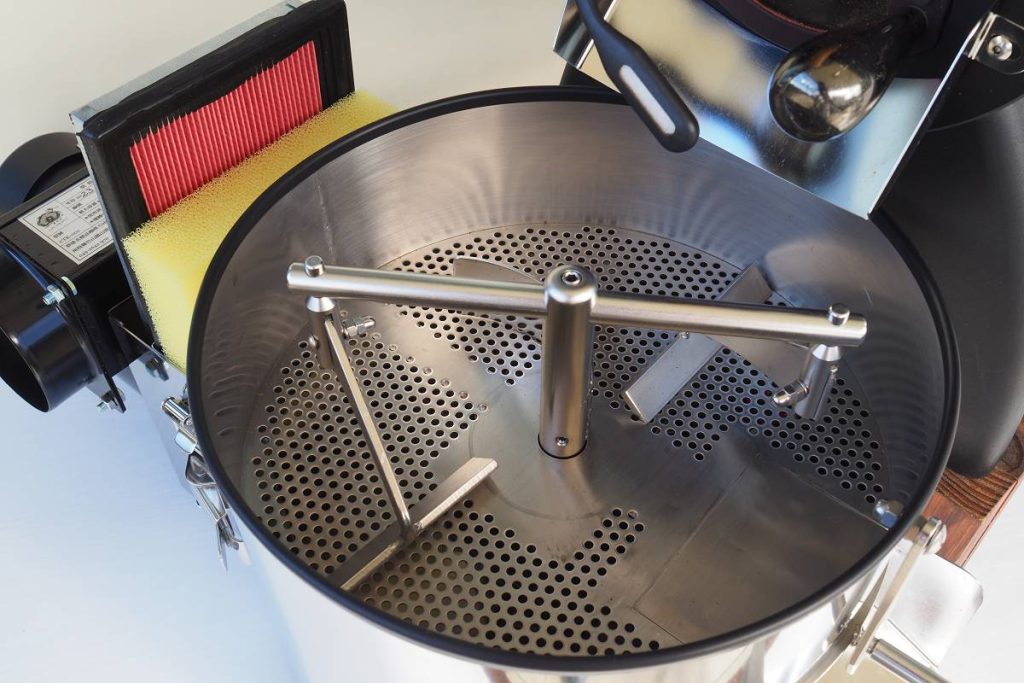
Café Naturêve Cooling Tray The Café Naturêve Cooling Tray uses a two-stage filtration system. The first filter mainly captures chaff and larger debris, while the second filter further captures finer particles. This design allows the cooling airflow to remove heat while also collecting chaff and dust of different sizes. The two-stage filtration system also helps reduce the amount of chaff and fine particles released back into the roasting room, which is especially useful when the cooling tray is used indoors. The first filter can be washed.
To maintain sufficient cooling airflow even with both filters installed, we use a large blower rated at 268 CFM, and the complete machine has a power rating of 150 W. This allows the cooling tray to handle chaff and fine particles while still maintaining substantial airflow capacity. Aillio lists the Pro Cooling Tray at 70 W, but does not currently publish an airflow rating in CFM, so the actual airflow of the two machines cannot be directly compared.
When using the Café Naturêve Cooling Tray, users can also choose to use two filters, one filter, or no filter at all, depending on their environment and needs. The fewer filters used, the lower the airflow resistance, and therefore the faster the cooling speed.
If your roasting space is next to a garden or open area where chaff can be safely exhausted outdoors, I strongly recommend removing both filters and venting the chaff directly outside. In this setup, cooling is extremely fast: approximately 700 g of coffee can be cooled in less than 1 minute at room temperature 25°C, while also eliminating the need to clean accumulated chaff from the filters.
For me, chaff management is not simply a cleaning issue. If extra time has to be spent dealing with scattered chaff and dust after every batch, it can noticeably reduce efficiency during long or consecutive roasting sessions. When designing the cooling tray, I wanted cooling and chaff collection to be handled within the same workflow.
Fast cooling combined with effective chaff management can make the overall roasting workflow much more efficient.
There are also several major design differences between the two cooling trays:
Power Supply
The Aillio Pro Cooling Tray is powered and controlled through the Bullet R2 / R2 Pro. This is very convenient because the cooling tray starts automatically after the PRS button is pressed to discharge the beans. However, its operation depends on the roaster’s control status, the cooling tray connector, and the connection between the two units. A small number of users have reported intermittent operating or possible connection issues. Others have reported difficulty connecting the Pro Cooling Tray to an R2. However, there is currently not enough evidence to consider these issues a widespread design defect.
The Café Naturêve Cooling Tray uses an independent power supply. The disadvantage is that the cooling tray must be switched on manually. The advantage is that it does not depend on the roaster’s control system, connection ports, or firmware status. As long as the bean discharge position and workspace layout are compatible, it can be used with different coffee roasters. One of our customers even uses a single Café Naturêve Cooling Tray with two Aillio Bullet roasters.
Convenience When Discharging Beans
When the Coffee Bag Spout is installed on the Aillio Pro Cooling Tray, Aillio’s instructions require the spout to be aligned with the edge of the table. This means some space along the table edge needs to be reserved for operation.
The discharge outlet of the Café Naturêve Cooling Tray is elevated above the tabletop, so it does not need to extend beyond the edge of the table. This gives users more flexibility when positioning the cooling tray within their workspace.
Both Cooling Trays Require the Roaster to Be Raised
The Aillio Pro Cooling Tray comes with Leg Supports. Once installed underneath the Bullet, they provide the additional height required for the Pro Cooling Tray, making the setup relatively convenient.
The height-extension legs for the Café Naturêve Cooling Tray are sold separately. They are larger than Aillio’s Leg Supports and require an additional installation step. Users can also have wooden or plastic supports made locally. Examples of customer setups and dimensions can be found in the “Customers’ Setups” section of our FAQ.
The two cooling trays follow different design approaches. The strength of the Aillio Pro Cooling Tray is its high level of integration with the Bullet system and its automation. The Café Naturêve Cooling Tray uses an independent design, giving users greater flexibility in terms of power supply, placement, and compatibility with different coffee roasters.
For me, cooling speed is only one part of a good cooling system. How well the cooling tray fits into the available workspace and the overall roasting workflow is equally important.
Fast Cooling. Better Chaff Management. A More Flexible Workflow.
Café Naturêve Cooling Tray was designed for fast, consistent cooling with flexible filtration and an independent setup for the Aillio Bullet R1 / R2.
Follow my step-by-step guide to roasting on the Aillio Bullet R1 / R2, from understanding your coffee to reading the roast profile and deciding when to end the roast.