Coffee cupping after roasting helps us connect flavor back to the roast profile. I use cupping to evaluate heat application, moisture release, roast defects, acidity and sweetness, and how different layers of the coffee developed.
I also pay attention to whenfloral and other aromas begin to appear, how strong they are, and how they change during resting. For me, these changes can reveal how much heat the coffee received, whether some flavors are masking others, and how long the coffee may stay at its best.
The goal is to understand what the cup tells us about the roast and use that information to make better decisions in the next batch.
mins
Reading Time
When Do I Cup Coffee After Roasting?
After roasting, I usually cup the coffee on the same day. The reason is simple: as a café owner and coffee bean supplier, I do not have time to wait for the coffee to rest.
Does this create problems? There are some limitations, because the flavors expressed on the day of roasting will not necessarily be the same as those that appear after several days of resting.
However, if we consciouslyinterpret the roast profile, understand the reason behind each input made during the roast, and then connect that information with the flavors and mouthfeel we actually taste, same-day cupping can still be very useful for evaluating how the roast was executed and how the coffee developed.
For me, the purpose of this cupping is not to predict every subtle flavor change that may appear several days later. It is to confirm whether my interpretation of heat transfer, moisture release, and roast progression during the roast is actually reflected in the cup.
Should We Rest Coffee After Roasting? Why Resting Improves Flavor
Yes. Proper resting generally makes coffee easier to brew. As the carbon dioxide that accumulated inside the beans during roasting gradually escapes, water can penetrate the coffee’s porous structure more easily during brewing, making extraction more stable.
In my understanding, this is especially important for areas deeper inside the bean that experienced relatively lower temperatures during roasting, expanded less, and developed a less open structure. If water cannot easily enter these tighter internal spaces, the soluble compounds within them may be more difficult to extract effectively, and some of the flavors already present in the coffee may not be fully expressed in the cup.
I believe many brewing problems are related to water being unable to sufficiently reach certain areas inside the coffee particles. I will discuss this topic in more detail in the Brewing Knowledge articles.
Resting coffee is not only about giving carbon dioxide time to gradually escape. Another important reason is that the coffee’s flavor and aroma continue to develop and change over time. (normally becomes stronger and richer)
These later flavor changes are built on the compounds that have already been formed and retained in the coffee by the end of the roast. It is difficult to predict exactly how the aroma and flavor will evolve afterward, but during roasting, we can at least influence how much terroir expression the coffee retains and how much roastiness is created.
I remember roasting a honey-processed Costa Rican coffee once. On the day it was roasted, I could only taste red berry, maple syrup, and red orange notes. Three days later, however, a noticeable wine-like aroma had appeared.
This is also why I keep emphasizing that understanding heat transfer and moisture release is more important than chasing a beautiful roast profile or specific numbers. The numbers can record what happened during the roast, but what ultimately determines how the flavor develops afterward is how we manage heat, moisture, and the characteristics of the coffee itself during roasting.
How Long Should Coffee Rest After Roasting?
With my roasting approach, I generally want the coffee to reach its peak in aroma and flavor around the 3rd to the 4th week after roasting.
Simply put, in my experience, coffees roasted with more aggressive heat application often open up earlier, but their shelf life may also be shorter. In contrast, when heat is applied more conservatively throughout the roast, the coffee may need more time before its flavors gradually open up and reach their peak.
If either of these situations becomes too extreme, I consider it an abnormal roast. In “Roast Defects On The Aillio Bullet R1 / R2,” I explain in more detail the results that these two different approaches to heat application may produce.
In situations where the coffee needs to show strong flavor within a short period of time, such as in some roasting competitions, roasters may choose a more aggressive heat application. I have tried this myself. The coffee tasted very expressive immediately after roasting, but after about one week, its aroma and flavor declined rapidly.
I have also tried the opposite approach by applying heat very conservatively. Right after roasting, it was obvious that the deeper layers had not developed sufficiently, yet after about a month, the flavor became much richer. I even had one roast that I thought was terrible when it was fresh, but after six months, it surprisingly became quite enjoyable.
But should we deliberately roast coffee this way?
For me, if the goal is to provide coffee consistently over the long term, a more balanced approach makes more sense. Coffee should not taste great only for a few days after roasting, nor should it require one or two months—or even longer—before it begins to show its normal flavor potential.
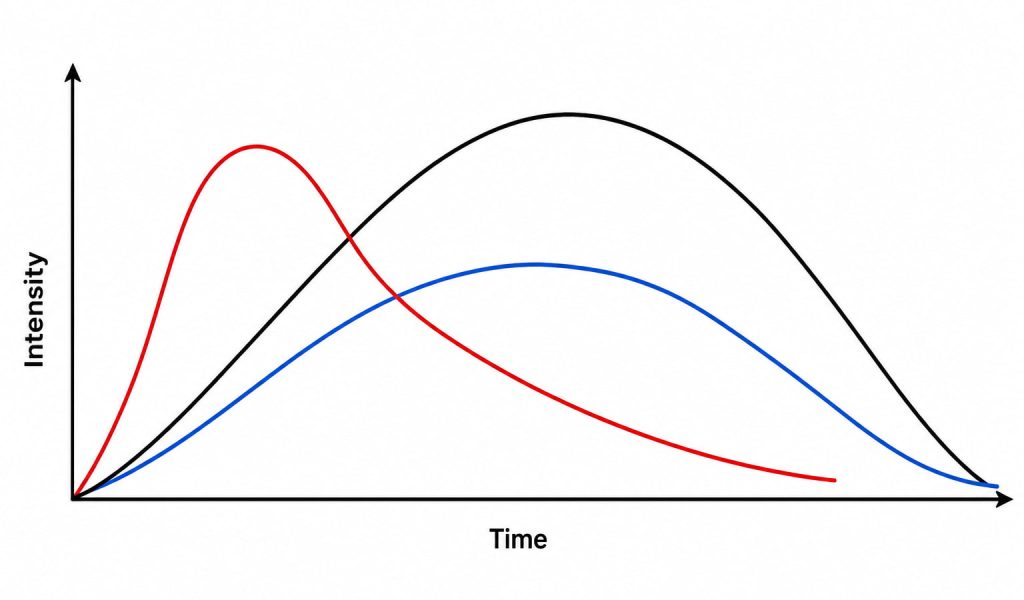
Excessive Heat Application
High intensity early on, but declines quickly, leading to a sharp drop in flavor.
Insufficient Heat Application
Slow development with lower peak intensity, resulting in a weaker overall flavor.
Proper Heat Application
Gradual development with a higher peak and balanced decline, achieving the best and most complex flavor.
Why I Use Cupping Instead of Brewing to Evaluate a Roast
The advantage of cupping is not that it eliminates variables entirely, but that, compared with regular brewing, many of those variables are easier to fix and standardize.
The main conditions that need to be controlled include water quality, water temperature, ambient temperature, and grind-related factors such as grind size, particle shape, and particle size distribution.
If we use a regular brewing method to evaluate a roast, the judgment becomes more complicated. During brewing, changing just one condition—such as grind size, water temperature, brew time, flow rate, or brew ratio—can also change the flavor in the cup. This makes it more difficult to determine whether the difference we taste comes from the roast itself or from the brewing method.
This is also why I wrote “Coffee Brewing Fundamentals: How Grind, Time, Temperature, and Ratio Work Together.” Among the many brewing variables that influence one another, I wanted to provide a clear priority that helps us understand what should be evaluated first and which adjustments should come later. If you regularly brew coffee, or if you want to understand coffee brewing more deeply, I strongly recommend reading this article.
In addition, I really like the way cupping allows extraction to continue as the coffee cools naturally over a relatively long period of time, usually around 8–12 minutes. This helps the continuity of flavors show itself more clearly, often creating a very beautiful combination in the cup.
Cupping also allows us to experience the coffee’s oils more fully. Many aromatic compounds are associated with the oil fraction of coffee, so retaining those oils can contribute to a more complete expression of aroma and flavor.
Here is a quick summary of the parameters I use for cupping:
Coffee dose: 11 g. I smell the dry aroma immediately after grinding.
Water volume: 200 mL (coffee-water ratio is 1:18.18)
Water temperature: 100°C boiling water
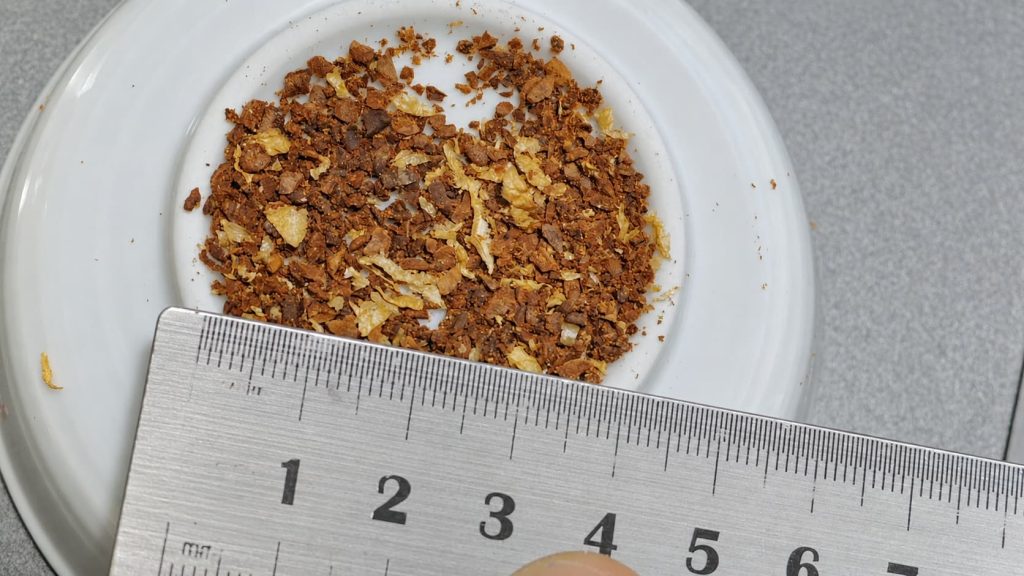
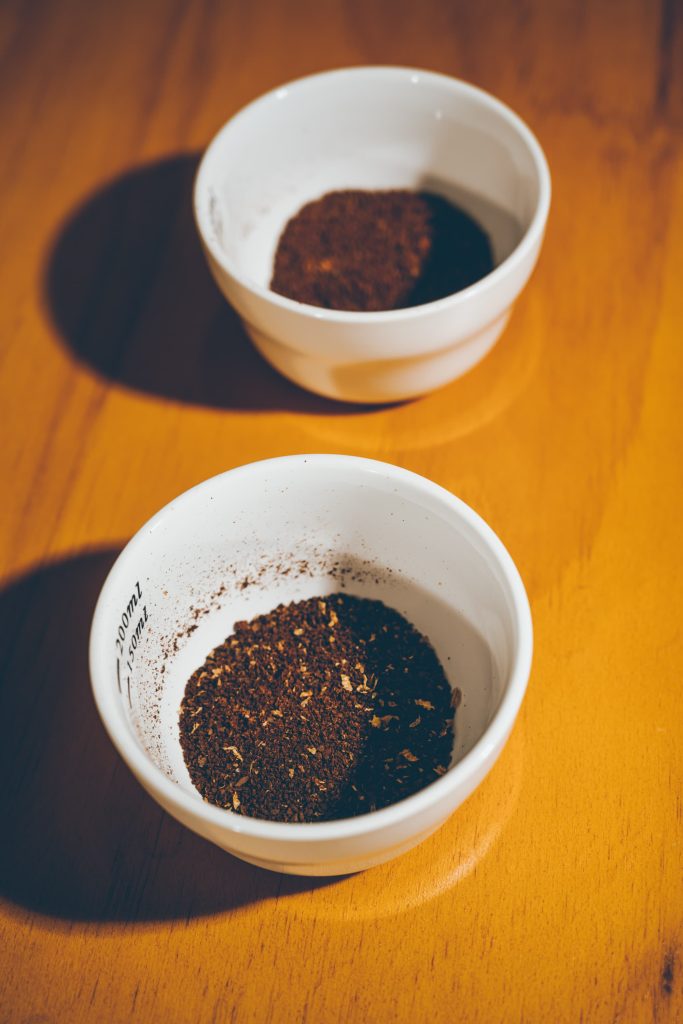
Grind setting: If you are using a home grinder, use a setting about one number coarser than what you normally use for pour-over. The grind size should look similar to the photo below. According to the official SCA standard, approximately 70–75% of the grounds should pass through an 850 µm sieve (US #20 sieve).
Break the crust at 4 minutes. I smell the wet aroma while breaking the crust.
Start tasting at around 8 minutes.
In my experience, extraction is most complete at around 10 minutes, and this is usually when the coffee tastes best.
Here is a cupping tutorial from Mill City Roasters that you can use as a reference.
What Flavors Do I Look For When Cupping a Roast
What Is the Masking Effect and How Can We Detect It?
It means that the flavors from some layers are more dominant and mask the flavors from other layers.
If the dry aroma after grinding has a peanut-like note, but the coffee during a cupping session does not really taste peanut-like—and may even taste very good, with floral and fruity notes—this is an example of the masking effect influencing our perception.
This section is very important, so I recommend reading it more than once.
Immediately after roasting, one thing I pay particular attention to is the coffee’s MASKING EFFECT.
Roasters often encounter a situation where the coffee tastes good on the day it is roasted, but by the second or third day, peanut-like, cereal-like, or other undesirable flavors gradually begin to appear.
In my understanding, immediately after roasting, the layers closer to the outside of the coffee bean may already show very good flavor expression, temporarily masking problems coming from deeper areas. As the coffee continues to degas over the following days, some of the more volatile aromas gradually change or weaken, and previously less noticeable defect flavors may become easier to detect.
Within my roasting framework, if a normal coffee repeatedly shows this pattern, the first thing I look back at is moisture release.
If the amount of moisture, as well as how much is released or retained, is not properly managed during roasting, heat may not be able to continue moving efficiently enough into the deeper layers. The result can be a coffee whose outer layers taste good while the internal development remains insufficient.
But that is not necessarily a problem, because it gives us something we can correct in the next batch.
During roasting, we consciously control drum speed, power, and fan speed, and we make our own decisions about end temperature and development time. Therefore, when a problem appears during cupping, we can connect what we taste back to the adjustments we made during the roast and understand which decisions may have led to that result, rather than simply following someone else’s recipe without knowing why it succeeded or failed.
These judgments and the practical adjustments behind them are discussed in more detail in the Member’s Section.
Related research on aroma masking: Kaneshima et al. (2022) investigated how volatile compounds from Arabica coffee can mask earthy and cereal-like notes in Robusta coffee extract. Although this study focused on coffee blending rather than post-roast flavor development, it provides an interesting example of how one group of aroma compounds can reduce the perception of another.
What Should Freshly Roasted Coffee Taste Like During Cupping?
When I cup coffee immediately after roasting, if it is a light-roasted coffee, I usually want to detect JUST A SMALL HINT of the notes described by the green coffee supplier. A slight hint is ideal, because to me, that suggests the heat application was just about right.
Too much aroma and flavors are not necessarily a good sign either. If the aroma is overly intense right after roasting, I take that as an indication that too much heat was applied, which may result in a shorter shelf life.
In my experience, when a coffee has received excessive heat, floral and fruity aromas tend to appear immediately after roasting.
When the heat application is just right, I usually find that fruity aromas are present right after roasting, while the floral aromas have not yet fully emerged.
For me, the ideal situation is when the floral aromas begin to appear around 7–10 days after roasting.
If we cup medium-roasted or dark-roasted coffees immediately after roasting, the aromas and flavors will be more intense than light-roasted coffee beans.
What Do the Tasting Notes on a Coffee Bag Actually Mean?
I often meet customers at the café who, after taking a sip of coffee, immediately start searching for the tasting notes listed on the menu to see whether they can actually “taste” those flavors. If they can, they are very happy. If they cannot, they may feel confused and even begin to wonder whether they simply do not understand coffee. Some of them then start talking with me about how long they have been drinking coffee, how many coffees they have tried, or how little they think they know about coffee.
As roasters, how should we look at this?
In my personal view, this is not only a matter of coffee knowledge. It also involves psychology and sociology. Since those are not my areas of expertise, I will not go too deeply into that side of the discussion.
I’d use the tasting notes given by the green coffee supplier directly.
Before buying green coffee, if we do not have the chance to attend a cupping, we often use the tasting notes provided by the green coffee supplier as part of our purchasing criteria. To me, these descriptions represent flavors that, somewhere along the path from origin to consumer, have appeared at some point through roasting and brewing.
For that reason, I usually do not actively change the tasting notes originally provided by the green coffee supplier. Instead, I try to roast the coffee in a way that gives those existing flavors a chance to express themselves. If I discover additional flavors through my own roasting and cupping that are clear and repeatable, I will then add them.
As a café owner, if a flavor is so weak that customers can only perceive it after being told what they are supposed to taste, I tend to feel that I still have room to improve.
For me, what a roaster really needs to learn is how to understand the nature of the surrounding heat environment, as well as the nature of the coffee itself, and then use roasting to bring out the flavor potential that is already there.
This is also why I keep emphasizing that understanding heat transfer, moisture release, and the balance between terroir expression and roastiness is more important than relying on data, graphs, or any single fixed metric.
This is something a roaster may spend a lifetime learning, and it is also one of the most important things I hope readers can truly take away from this website.
How to Bring Out Floral Notes in Coffee Through Roasting
Quick answer: Do not let the roast progress too far after First Crack.
Here, I am not trying to discuss the chemical composition of floral aromas. I want to focus on the thermal background behind floral notes, because the timing and intensity of floral notes are important indicators I use to judge whether a coffee has received too much heat.
As I mentioned earlier in this article, I usually cup my coffee on the same day it is roasted. If I can already taste obvious floral notes during that cupping, I do not consider it a good sign. To me, it indicates that the coffee has received too much heat.
As the coffee approaches First Crack, intense chemical changes begin to take place. In my experience, the flavor progression tends to follow this sequence:
If the floral notes are too obvious, it means that too many layers have already received sufficient heat, causing them to mask the flavors from other layers. What is the downside of this? Floral aromas are highly volatile. If too many floral notes appear too early, much of that floral character may have faded after around 14 days.
Honey offers a useful comparison. When honey is stored at room temperature for years, Maillard reactions can gradually make it darker in color and deeper in flavor. Coffee also goes through a similar kind of “maturation” or “aging” after roasting. Freshly roasted coffee should retain an appropriate degree of freshness, allowing some layers to continue maturing / aging at room temperature.
A roasting fellow in Canada once told me that he had measured his own roasted coffee and found that its color did in fact become slightly darker after two days.
If you want to practice roasting coffee to achieve just the right amount of floral character, I think washed Ethiopian Yirgacheffe is the best choice to start with, followed by honey-processed and natural-processed coffees.
How Can We Control the Intensity of Floral Notes?
Quick answer: I would usually first consider shortening the development time.
However, development time should not be viewed in isolation. If shortening development results in obvious peanut-like or cereal-like flavors, it suggests that the deeper layers have not received enough heat. In that case, I would consider slowing the overall roast progression while still keeping the RoR developing naturally and continuously.
However, slowing down the overall roast only makes sense when it is done within the right framework.
If the underlying assumptions or decision-making framework are wrong, then even a carefully designed controlled experiment—adjusting power, time, fan speed, or even development time—may only lead to a solution that is relatively less bad under the wrong physical and chemical conditions.
In the Member’s Section, I will provide a complete decision system. The most important part of that system is priority: what should be judged first, what should come later, and how to coordinate power, fan speed, drum speed, heat, moisture, and time under different conditions.
Why Does My Coffee Taste Like Peanuts?
Because the heat did not reach deep enough into the inner layers of the coffee bean.
In my “Roast Defects article“, I mentioned that this is more commonly found in washed coffees. However, as long as the heat fails to reach the deeper parts of the bean, this roast defect can occur regardless of the processing method.
Many roasters, in pursuit of extremely intense floral notes, can end up creating this defect. Some people also describe this type of roast defect as a cereal-like flavor.
In some cases, this flavor may fade after the coffee has rested for a period of time.
When Coffee Tastes Vegetal or Green
This is because too much moisture was retained during the roast, allowing excessive moisture to remain as the coffee entered the later chemical reactions.
Sometimes the flavor can even resemble Chinese herbal medicine or herbal tea. Airflow plays a major role in this, but it also needs to be considered together with the overall roast settings.
Why Does My Coffee Taste Muted?
This is also related to how much moisture is retained.
The muted flavor I am referring to here is different from the blandflavor discussed in the next section.
In the previous section, I mentioned that retaining too much moisture can result in vegetal bitterness. If the roast is improved somewhat, the vegetal bitterness may disappear, but the coffee can still taste muted or closed, as if the flavors cannot fully open up. At this stage, too much terroir expression is still being retained. This type of roast defect does tend to occur more easily in washed coffees.
Controlling moisture to the “just right” level is extremely difficult. If far too much moisture is retained, the coffee may show vegetal bitterness. With some improvement, the flavors may still feel compressed together and remain difficult to distinguish. If too little moisture is retained, however, the coffee may have almost no flavor at all.
In my framework, controlling moisture is essentially the same as controlling terroir expression.
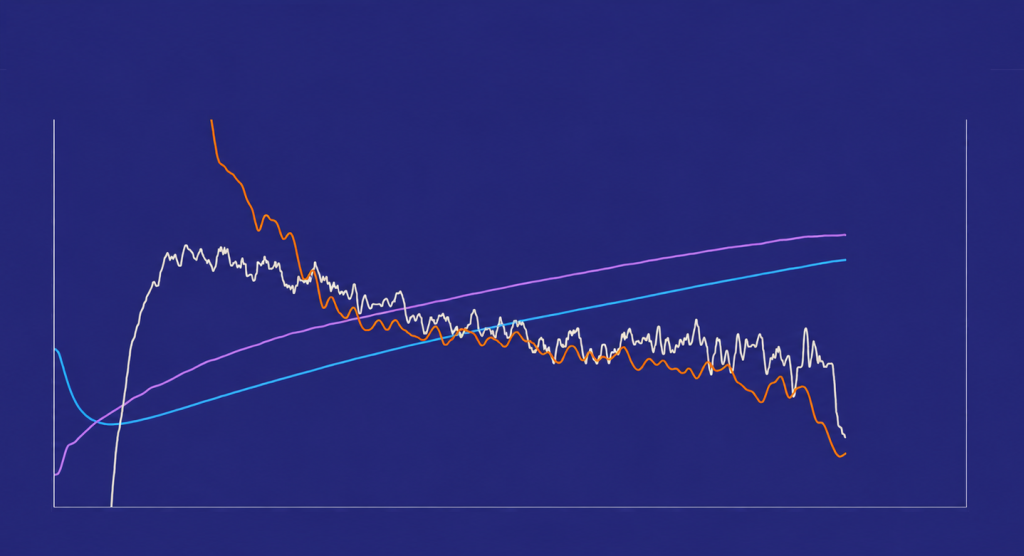
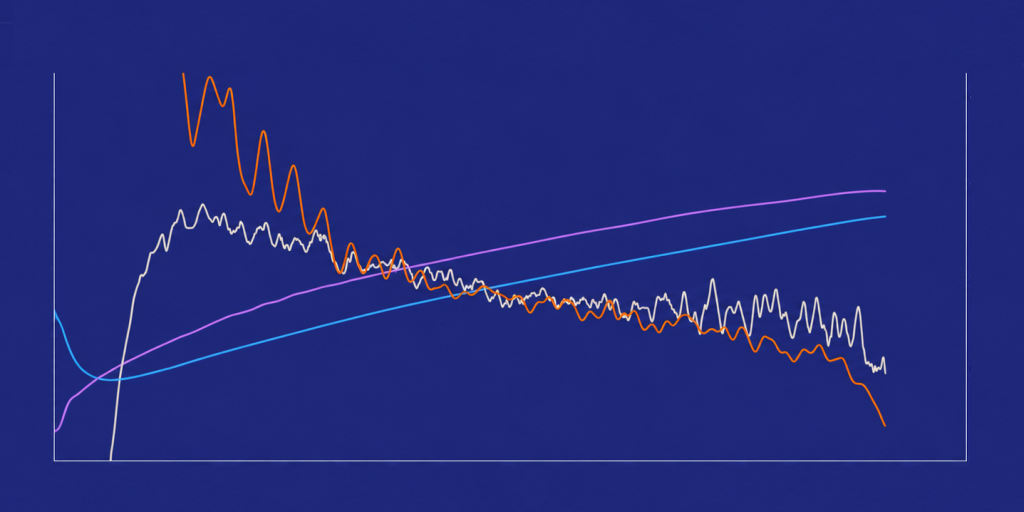
This is a Roastime profile of Ethiopia Ajere Washed Coffee. Muted flavor, but the profile doesn’t looke very bad, right? However, the crash at the end is the hint.
Why Does My Coffee Taste Bland?
There are two main reasons:
Insufficient heat
Too much moisture—and with it, too much terroir expression—was removed
The bland flavor I am referring to here is different from the muted flavor discussed above.
Roasting coffee is, in many ways, about adjusting the balance between terroir expression and roastiness, and terroir expression is gradually lost as moisture leaves the coffee. When too much moisture is removed, the cup can also become bland or flat.
Another not-so-bad proifle but in reality a bland cup. Ethiopia Taratu Washed.
Does a Stronger Aroma Mean a Better Roast?
If you are a coffee bean seller, I would not recommend roasting this way.
The more aromatic a coffee is immediately after roasting, the more heavily it has been heated, and the shorter its optimal drinking period may be. As I mentioned above in “What Should Freshly Roasted Coffee Taste Like During Cupping?”, when I cup coffee immediately after roasting, I usually want to detect only a small hint of the aromas described by the green coffee supplier. A slight hint is ideal, because to me, that suggests the heat application was just about right.
Adjusting the balance between acidity and sweetness is usually approached by adjusting development time (DT).
During cupping, sweetness is one of the indicators I pay very close attention to. Even if a roast has other defects, I still want the cup to retain a certain level of sweetness.
Sweetness can soften acidity and bitterness, and it also affects the finish and the overall mouthfeel. For me, achieving a good balance among acidity, sweetness, and bitterness is an important part of evaluating a roast.
Sweetness Is Not Determined by End Temperature Alone
I used to believe that as long as the end temperature was high enough, and there was sufficient browning and caramelization later in the roast, the coffee should also have enough sweetness.
Later, I realized it was not that simple. Even if the layers closer to the bean surface already show enough sweetness, the cup can still taste unbalanced if the deeper layers retain too much acidity or remain incompletely developed.
This is also why simply asking, “At what temperature did you drop the coffee?” is far from enough for me.
The end temperature only reflects the result at the bean surface. We also need to understand the nature of the coffee itself, the environmental conditions, the available heat, the amount of moisture present, and how that moisture is removed.
No matter how many times I repeat it, I still want to emphasize this point: for me, these factors are far more important than chasing any single number.
No Crack Roasting: Sweetness Without a High End Temperature
When I experimented with No Crack roasting, this idea became even clearer to me. (No Crack refers to a roast in which there is no obvious audible First Crack.)
According to Taiwan-based Lab 19 Coffee Roasting, their No Crack roasts can show:
Fuller and more structured in flavor. Sweetness is significantly enhanced, particularly in fresh fruit notes and hard candy like sweetness.
The end temperature of a No Crack roast is usually lower than that of many conventional roasts that go through an audible First Crack. Yet in the cup, these coffees do not necessarily lack sweetness, nor do the deeper layers necessarily taste obviously underdeveloped.
This makes me believe even more strongly that we cannot judge whether a coffee is fully developed simply from the end temperature shown at the bean surface.
In my understanding, this is also related to the masking effect. Even if the bean surface does not reach what we would normally consider a “standard” end temperature, the final sweetness and overall flavor can still be complete as long as most of the relevant layers inside the coffee have received appropriate heat and the right amount of moisture has been removed.
Because what we actually taste in the cup is never the flavor of just one layer. It is the combined result of all the layers together.
I will explain how I use the No Crack approach on the Aillio Bullet R1 / R2 in the Member’s Section.
Ugly No-Crack Roasted Ethiopian Halo Bariti Washed coffee, with much of the chaff still clinging to the beans. The flavor is good, however.
How to Adjust the Next Roast After Cupping
I will leave the more advanced knowledge in this section for the Member’s Section.
When solving roasting problems, we should avoid treating only the symptoms while leaving the root cause unresolved, or relying on too many one-dimensional fixes.
For example, if we feel that the terroir expression is too strong, simply increasing the airflow is not necessarily the best solution. A roaster needs to understand the priority of each variable and coordinate preheat temperature, drum speed, power, fan speed, and time with one another.
Back when my roasting was still less consistent, I remember a customer tasting my coffee and asking me, “What fan setting do you use?” At that moment, I honestly did not know how to answer.
I did not know which roaster he was using. Even if I had known, I might not have been familiar with that machine. And even if he was also using a Bullet, I still could not be sure whether he was willing to discuss the question by starting from the fundamental nature of the coffee itself and the environmental conditions.
The duration of each phase is the result of the adjustments we make. It is not the reason a coffee tastes good or bad.
What is more difficult is making more fundamental adjustments to power, fan speed, and drum speed. Once these conditions change, heat transfer, moisture release, and the coffee’s RoR will also change, and the duration of each phase will naturally be different.
And no matter what adjustments we make, or what the roasting plan for the next batch may be, there is one thing I keep emphasizing:
Roasting must follow the natural progression of the RoR.
Only by following the coffee’s available heat and the natural progression of the RoR can the different inner and outer layers form a continuous and natural gradient.
This is also why I have spent so much time writing free articles about RoR. If you have not read them yet, take a look at 1.3 RoR (Rate of Rise) under C. Heat & RoR Control. There are three fundamental articles in that section, and I highly recommend reading all of them.
Coffee Roasting Is Much More Dynamic Than We Think
Roasting is not a fixed set of settings that can be applied to every coffee and every environment. Take drum speed as an example. Some people online insist on using D9 for every roast. One reason may simply be that the coffees and roasting conditions they work with do not change very much.
But even a small change in thermal conditions can change the final flavor.
When the coffee changes, the surrounding thermal environment changes, or the moisture condition changes, the roaster needs to make different decisions. In a way, we are like wizards controlling invisible heat, and we need to treat different coffees and different environments differently.
The fact that many mass-produced coffees do not taste very good is not necessarily just because they use cheaper commercial-grade coffee. Another important reason that is often overlooked is that different coffees and different environmental conditions are not given sufficiently differentiated treatment.
If a roaster truly knows how to adjust according to the coffee itself and the thermal environment at that moment, even inexpensive commercial coffee can still taste very good.
When it comes to roasting, I am very strict with myself.
I try to avoid all of the roasting defects mentioned above. If a problem becomes even slightly serious, I may sell that batch at a discount to friends I know rather than offer it as a regular product.
Only by continuing to hold ourselves to a high standard, and by being willing to admit that every roast can still be improved, do we have a chance to truly progress.
I think roasters generally fall into three different ways of thinking:
Those who barely look at the roast profile at all—they put the coffee in, wait until the temperature reaches a certain point, and drop it.
Those who believe only in the roast profile and blindly pursue an ideal-looking curve.
Those who are willing to spend time understanding the nature of the coffee itself, while reading the roast profile and also understanding the reason behind every decision, as well as how each adjustment may affect the final flavor.
Which kind of roaster do you want to become?
How to Roast
Ready to Put These Ideas Into Practice?
Follow my step-by-step guide to roasting on the Aillio Bullet R1 / R2, from understanding your coffee to reading the roast profile and deciding when to end the roast.