Many coffee brewing problems are not caused by a lack of recipes. They often come from adjusting the wrong variable first, or from treating grind size, time, temperature, and brew ratio as separate settings instead of connected decisions.
This article explains how I decide which brewing variable to adjust first, how grind size, time, temperature, and brew ratio affect each other, and why continuity and flavor layering matter in the final cup.
My perspective comes from roasting with the Aillio Bullet and brewing thousands of cups for customers in my physical coffee shop in Taiwan, at outdoor markets, and across different seasons of the year.
Quick FAQ
Which variable should I adjust first when brewing coffee?
Grind size. Every coffee has a different bean structure, so grind size should usually be the first decision.
Why should grind size, brew ratio, and brew time be considered together?
Because a finer grind extracts faster, usually needs a lower brew ratio, and often shortens the total brew time. If the brew time becomes too short, the cup may not develop enough flavor depth.
How coarse or fine should I grind my coffee?
Usually finer for washed coffees, lighter roasts, smaller beans, and denser coffees. Usually coarser for darker roasts, larger beans, and softer coffees.
Why does continuity affect flavor in coffee brewing?
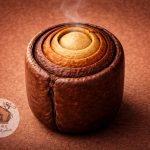
Because coffee is built in layers (color gradients). If one layer is extracted too strongly, the cup can feel broken, sharp, or uncomfortable.
A quick note for Bullet users:
All brewing articles in this guide are based on properly roasted coffee. For many Aillio Bullet users, the final missing step is fast and consistent cooling after drop.
Our Aillio Bullet R1/R2 cooling tray helps make this step cleaner, faster, and more stable.
How Time, Temperature, Grind Setting, and Brew Ratio Work Together
How should we use these brewing variables? If I had to summarize it in one sentence: time is most closely related to temperature, and grind setting is most closely related to brew ratio.
The longer the brew time, the more the temperature drops. The finer the grind, the less water is needed for extraction. This principle never changes.
One thing to keep in mind is that when the brew ratio is lower, the bloom time should be slightly longer. This helps maintain a similar total extraction time. Without a similar total extraction time, the overall temperature drop will not be sufficient, and the cup may not develop enough flavor complexity.
How Should We Decide the Grind Size?
Coarser
Finer
Natural
Washed
Dark Roast
Light Roast
Larger Bean
Smaller Bean
Please see the Grind section: Grind Size, Fines, and Grinder Limitations in Coffee Brewing
Or the section I will complete later: How I Brew My Coffees.
How Many Degrees Should the Water Temperature Drop During Pour-Over Brewing?
When water has just been heated to the set degree and is sitting in a pour-over kettle with the lid closed, the temperature usually drops by about 1°C every 30–40 seconds. From this, we can understand that time and temperature are absolutely connected.
I have brewed thousands of cups of coffee, and based on my experience, coffee tends to taste better when brewed in winter in Taiwan. During winter here, the indoor temperature is usually around 20–25°C. Under these conditions, by the time one cup of coffee is finished, the water in the pour-over kettle naturally drops by about 3–4°C.
Brewing Coffee In Winter
In winter, when necessary, I will also raise the temperature of my temperature-controlled kettle by 1°C or 2°C to compensate for the fact that the coffee beans themselves are colder.
The result can be very delicious. It is somewhat similar to how coffee naturally cools during cupping. Although cupping and pour-over brewing have many different conditions, the principle of natural cooling is the same. Natural cooling is also something I always look for when brewing pour-over coffee.
Brewing Coffee In Summer
In summer, when air conditioning is on indoors in Taiwan, the room temperature is usually around 27–30°C. To make sure the brewing process can still drop by at least 2°C, I sometimes turn on a fan and let it blow from a distance.
However, coffee still tends to taste better in winter. Besides the lower temperature, winter air is also usually lower in humidity and cleaner.
What Is the Right Total Brew Time for Pour-Over Coffee?
I usually keep the total brew time between 1:40 and 2:00. Within this time range, the water temperature usually drops by about 2–3°C, which tends to taste very good.
As mentioned earlier, the difference between summer and winter changes how quickly the water temperature drops in the pour-over kettle. In winter, the temperature drops faster, because the greater the temperature gradient between two objects, the faster the cooling rate.
Some smart readers may have a question: in summer, instead of turning on a fan, can I simply make the intervals between each pour longer and extend the total brew time to 3–5 minutes? Wouldn’t that also create a natural cooling effect?
In my view, the total brew time still should not be dragged out too long. The reason is that the coffee bed and the pour-over kettle do not lose heat at the same rate. If the difference between the two becomes too large, the flavor continuity can also suffer.
There is another important reason: coffee aroma compounds are very light and volatilize quickly. The longer the brew takes, the more aroma is lost.
Do not simply believe the common claim online that a longer total brew time always makes coffee more bitter and astringent.
That conclusion describes coffee brewing in a too simple way.
If that were true, why can cupping still taste good at the 10-minute mark?
Why Changing One Brewing Variable Affects the Others
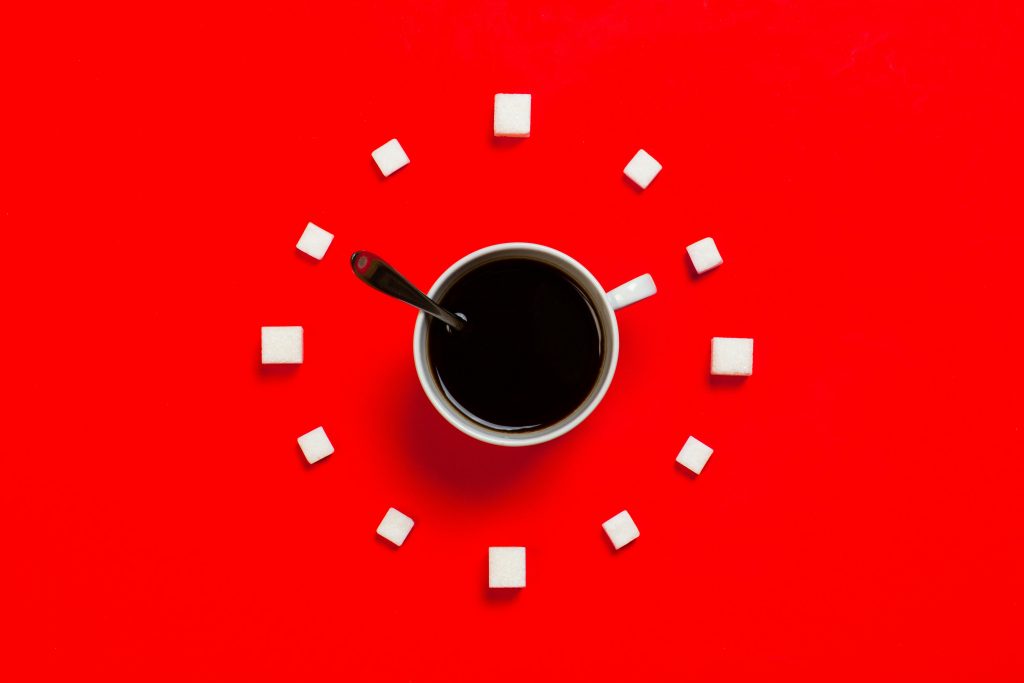
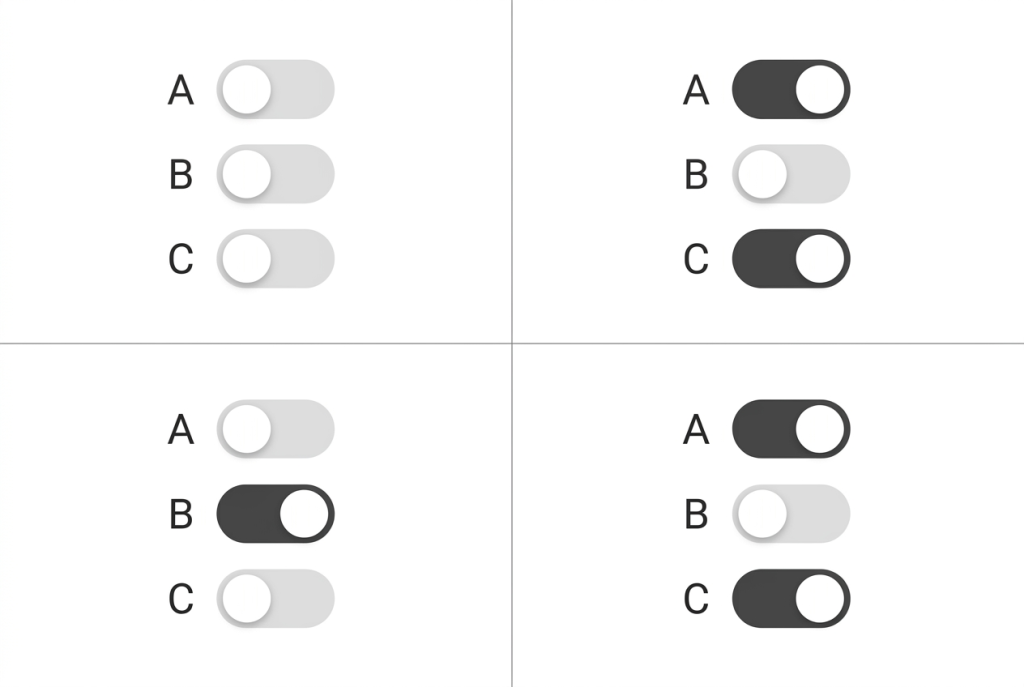
The main reason is that coffee aromas are too sensitive and vulnerable. Almost every variable can affect the flavor, and these variables behave like a toggle game: they constantly restrain and influence one another. The image below is a metaphor for this idea:
Therefore, when you adjust one variable, it will inevitably affect the others. But no matter how you adjust them, coffee brewing should not violate the fundamentals mentioned in this chapter. I also consider these fundamentals to be first principles.
Time and Temperature: The Chemical Side of Extraction
I think temperature can be understood as having a more “chemical” influence. Temperature mainly affects aroma type. When a certain temperature is reached, certain chemical bonds may break, causing the flavor to change completely.
In addition, temperature directly increases molecular kinetic energy, which, within a reasonable range, can increase the extraction rate. If it goes too far, however, too many of the good aromas will volatilize.
Grind Setting and Brew Ratio: The Physical Side of Extraction
As mentioned earlier, the cells inside coffee beans are very small. This is especially true for small beans, such as Yemeni coffees. They must be ground fine enough so that water can reach the inside of those cells and dissolve the compounds within them.
These days, I would rather grind slightly finer and then adjust the brew ratio accordingly.
A Simple Rule Before Changing Any Brewing Variable
Many people want a useful, universal formula, but this kind of formula does not exist. That is the beauty of coffee, also a difficulty for us. So I recommend reading the first section Coffee Brewing Variables: Which One Should You Adjust First? again.
At the very least, the grinder setting should be fixed first before adjusting other variables. Please ask your grinder seller to understand which grind setting is appropriate.
How Do I Know If the Coffee Is Ground Too Fine?
If you taste alkaloid-like notes, it usually means the coffee is ground too fine. The internal compounds of the cells have been washed out.
Especially when Ethiopian natural coffees are ground too fine, this flavor can appear very easily. I would even describe it as: tight, dry, or astringent.
How Do I Know If the Brewing Temperature Is Too High?
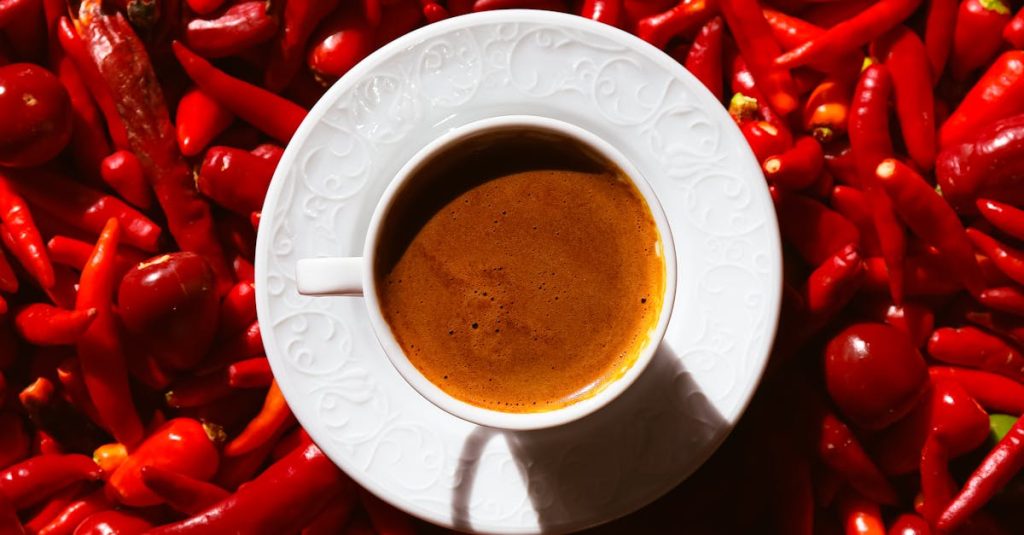
When brewed too hot, the coffee usually gives a slightly “spicy” or irritating sensation in the mouth.
How Should We Adjust Parameters to Match Customer Preferences?
Based on my experience in the coffee shop, customers usually only ask for the coffee to be “stronger.” Given this request, we need to understand how to use brew ratio.
If a customer wants a richer and stronger cup of coffee, we should make the grind setting slightly finer to make sure the full range of compounds can be extracted. In this case, the brew ratio should be lowered, because the grind has already become finer. When brewing this cup, remember to let the bloom sit a little longer after the first pour—at least more than 35 seconds.
Coffee extraction works within this framework. We stretch or compress the variables moderately to obtain the flavor we want.
Coffee Brewing Variables: Which One Should You Adjust First?
There are many things to pay attention to when roasting coffee, and they don’t all matter equally—there’s a clear order of priority. Brewing coffee is the same. In my view, the priorities should follow the order below:
- Choose the appropriate grind size based on the coffee’s bean structure and the roast end temperature.
- Decide the coffee-to-water ratio based on the roast’s weight loss (WL) for that batch.
- Choose the right dripper based on the coffee’s flavor direction. Decide the water temperature according to the roast level.
- Fine-tune the water temperature according to the day’s brewing environment (mainly ambient temperature).
Why Brewing Coffee Should Follow An Order of Priority
Brewing variables can be broadly divided into two categories: those that are primarily physical in nature, and those that are primarily chemical.
Physical variables (such as grind size) generally need to be addressed before chemical variables (such as temperature). The reason is simple: the cellular structure of coffee seeds is extremely dense and not easily extracted — unless long immersion allows soluble compounds to leach out on their own.
Before water can begin dissolving soluble compounds, physical conditions must first allow water to effectively contact and influence the coffee’s cellular structure. Only once this prerequisite is met can chemical extraction reactions meaningfully occur.
This is why brewing variables are not parallel considerations, but must follow a clear order of priority. This is why grind size should always come first.
Further reading: Grind Size, Fines, and Grinder Limitations in Coffee Brewing
Continuity of Flavor in Coffee Brewing & Roasting
Continuity is important in coffee. When a coffee’s flavors lack continuity, the cup can taste strange—unsettling and uncomfortable to drink.
What Is Flavor Continuity in Coffee?
There is a transition from acidity to sweetness, and another transition from sweetness to bitterness. The same is true between different flavor notes—there should be a process, not abrupt jumps.
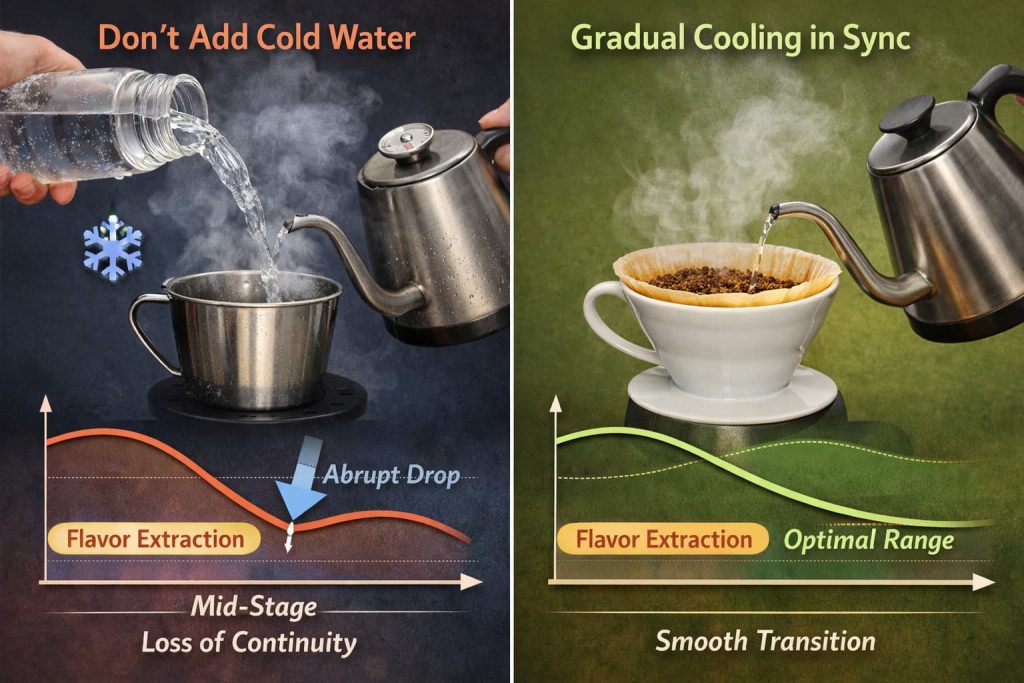
I recommend not adding cold water into your pour-over kettle during brewing, because you want the dripper’s temperature and the water temperature in the kettle to cool down naturally in sync. Adding cold water means sacrificing the mid-stage temperature range—the range where temperature changes help transform and extract key compounds—resulting in flavors that lack continuity.
The transition is actually a process. Take one Ethiopian bean for example:
Ethiopia Haderaro,
Guji, Mormora, 7487 / 7440,
Natural Process.
What If your Coffee Lacks Continuity?
The flavor notes are violet, apricot, and chamomile. There should be a transition between these profiles as well. If those transitions are missing, the cup will taste strange.
Earlier, I explained this from a sensory perspective: when a coffee lacks flavor continuity, it tastes strange and gives an impression of disharmony. From a more scientific perspective, my understanding is that different aroma compounds have different levels of volatility and different molecular properties.
Floral notes often feel lighter and more volatile, fruity notes may sit in the middle, and nutty notes tend to feel deeper and heavier. If there is no smooth transition between these layers, the coffee can indeed feel more one-dimensional.
Different aroma compounds vary in molecular weight and volatility:
Floral
Lighter (More Volatile)
Fruity
Middle
Nutty
Heavier (Less Volatile)
Why I Don’t Chase Molecules or Infused Flavors
Before you truly understand these brewing principles, don’t get lost in debating which types of molecules produce which flavors—because that already goes beyond what humans can realistically comprehend and control.
Yet people often miss the point and chase nothing but sensory “highs.” As a result, infused coffee beans have started to flood the market—and I strongly disagree with these practices.
In some articles in the Aillio Bullet Roasting section, I’ll also discuss continuity in roasting.
Flavor Layering in Coffee: How Different Flavors Combine
The flavor of a cup of coffee is not a single taste generated from ONE bean as ONE UNIT. It is a COMBINATION of different layers within the coffee bean.
What Flavor Layering Means
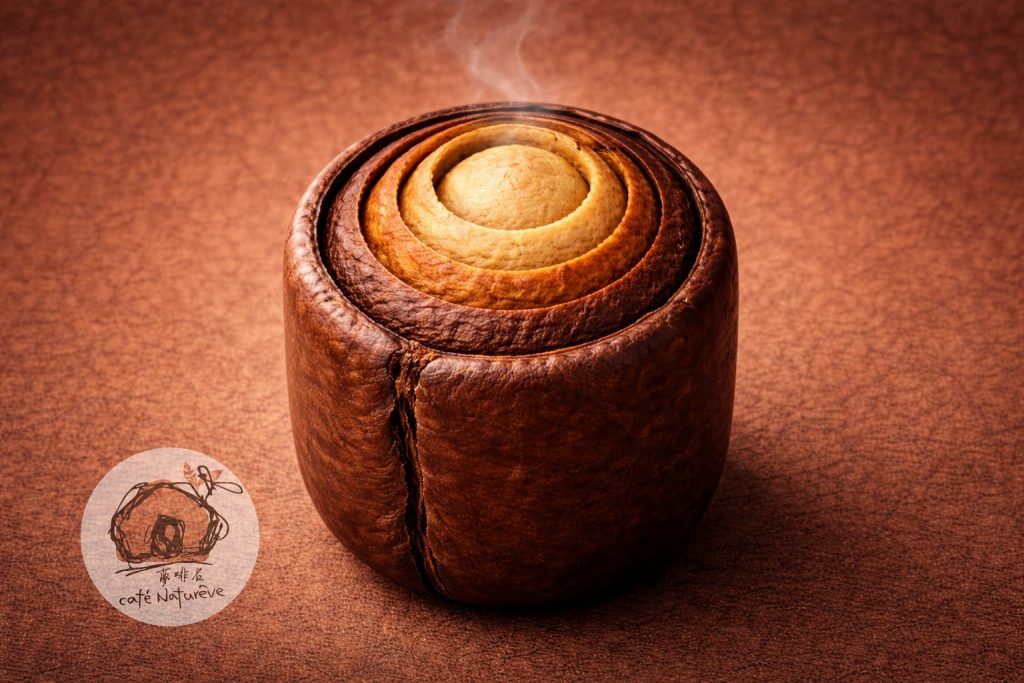
Because a coffee bean is the seed of a fruit, it is very hard and made up of dense cellular structures. During roasting, heat does not move through the coffee bean easily or quickly. The internal difference created by this slow transfer of heat from the outside toward the inside is what I call layering.
Why I Use “Layer” as a Metaphor
A coffee bean is small, but it still has thickness. To us, that distance may seem tiny and short. But for heat transfer, it is a distance that many roasters consider very long. The core of the bean is often the farthest place for a roaster to reach.
For a detailed visual reference of coffee cherry anatomy, see Sweet Maria’s article on the Arabica coffee cherry cross-section.
The image below is the metaphor I use for “layer.” Besides being easier to understand, it also works well for explaining the idea of continuity mentioned above.
How Roasting Creates Different Layers from Outside to Inside
Because heat transfers slowly, the surface and the core of the bean develop differently during roasting:
Surface
Core (Inner part)
Temparature
Higher
Lower
Roast Level
Darker
Lighter
Loss of terroir / moisture content
More
Less
Cell Expansion
Greater
Smaller
These differences make each layer fundamentally different, both structurally and in terms of flavor.
During roasting, each layer develops to a different degree. A competent roaster must have the ability to control these layers. What exactly needs to be controlled? The roaster needs to control how much terroir and moisture content each layer loses, and how much heat each layer receives. This is what I will discuss in the fundamental roasting section as gain and loss.
How RoR Control Affects Flavor Layers in Coffee Roasting
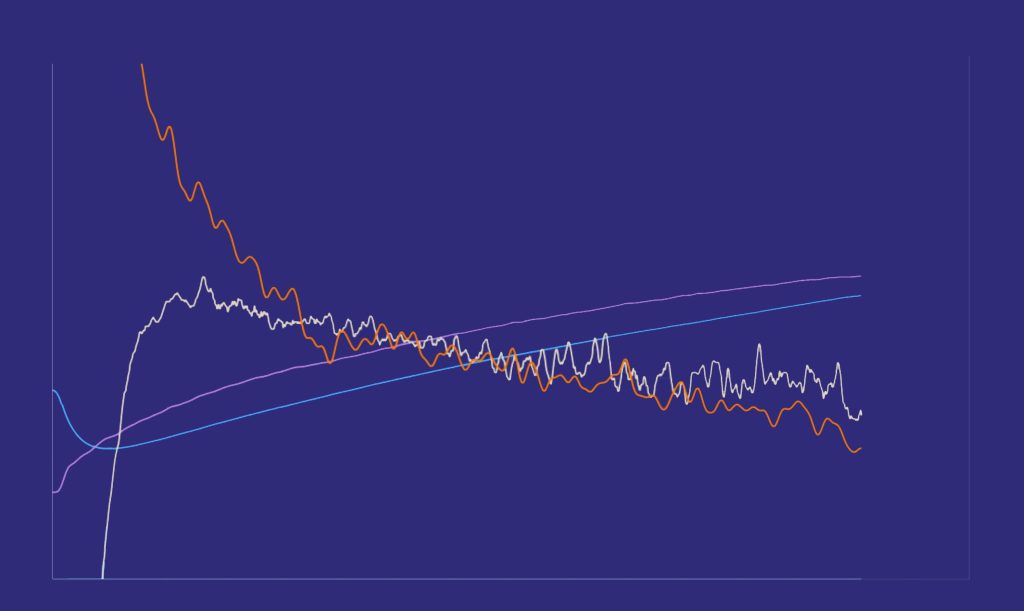
Technically speaking, if I had to explain in one short sentence how to create smooth layers during roasting, I would say: control the RoR (Rate of Rise).
Further reading: What Is RoR in Coffee Roasting? How to Read Rate of Rise on the Aillio Bullet?
For me, smoothness means that there should be a gradient from darker to lighter areas inside the bean.
The most important thing is to avoid a crash. Once a crash happens, it means that heat energy suddenly breaks, and heat can no longer continue moving inward smoothly. A crash after first crack is comparatively less serious. In general, the later the crash happens, the less damaging it tends to be.
Know more about Flick And Crash in this article: RoR Shapes in the Aillio Bullet R1 / R2
How Coffee Brewing Extracts Different Flavor Layers at the Same Time
If you can create a smooth development gradient inside the coffee bean during roasting, you are actually building more flavor possibilities within the same bean. This gradient is what I imagine as good layers.
When you brew coffee, the variables you choose—grind size, brew ratio, water temperature, time, flow rate, and so on—are essentially deciding how you extract these different layers at the same time, and how each layer appears in the cup. The final cup of coffee you drink is the total sum and combination of all the layers extracted throughout the brewing process.
How a Well-Layered Cup Tastes Compared With a Broken Cup
When the color difference between the outside and inside of the bean is just right, and when the gradient is well developed, the result is what I would call a well-layered cup. It has smooth transitions, tastes harmonious and pleasant, carries delicate acidity, has enough aroma, and is supported by an appropriate body.
By contrast, when the gradient is not well developed, the result is a broken cup. It often tastes flat and one-dimensional. It may lean too strongly toward a single direction. It may taste too sour (or/and) too bitter (or/and) even hollow. If the roast curve has a severe crash in the middle stage, the coffee may even carry a raw, vegetal character in the cup.
I have listed most roast defects that most Bulleters may encounter. Feel free to read this post: Roast Defects On The Aillio Bullet R1 / R2
Is Your Light Roast Truly Light?
Many brewing problems begin before brewing. Explore our free Bullet roasting guide and learn how heat, development, and post-drop handling shape the cup.