RoR, or Rate of Rise, shows how quickly the bean temperature is changing during a roast. In coffee roasting, RoR is often used to monitor thermal momentum, avoid flicks or crashes, and understand how heat is moving through the batch.
However, RoR should not be understood only as a curve-shaping tool. A gradually declining RoR often reflects how heat transfer, moisture release, and the coffee’s internal structure are changing during the roast. When the curve is read together with time, bean characteristics, machine behavior, and the final cup result, it becomes much more useful than a simple number on the screen.
I have been roasting with the Aillio Bullet since 2017, and most of my understanding of RoR comes from comparing roast profiles with actual cup results. For this reason, I do not read RoR only as a technical curve. I read it as a record of how the coffee responded to heat, moisture movement, machine settings, and environmental conditions.
Quick FAQ
What is RoR used for in coffee roasting?
RoR is used to monitor the bean’s gain and loss during roasting. Gain means momentum, while loss is related to moisture content and terroir.
Should RoR always decline during roasting?
Yes in a healthy roast. Having a declining RoR means more and more moisture is being released in succession. This implies that “moisture chain” in a coffee bean has not been broken, too.
Does a beautifully declining RoR curve always mean a better cup?
Not necessarily. A delicious cup usually comes from a balanced relationship between gain and loss across the layers of the coffee bean.
mins
Reading Time
All roasting articles in this guide are based on properly roasted coffee. For many Aillio Bullet users, the final missing step is fast and consistent cooling after drop.
Our Aillio Bullet R1 / R2 cooling tray helps make this step cleaner, faster, and more stable.
Since the term is already so familiar, I quickly asked Gemini to explain RoR in fifty words:
RoR indicates the speed of temperature change over a specific time interval (usually 30 or 60 seconds). It shows how fast beans are heating, helping roasters anticipate developmental milestones and manage thermal momentum to avoid stalling or scorching the batch.
Most people in coffee roasting have already heard this term many times. The basic definition is not difficult. The real question is how to interpret RoR during an actual roast.
Many roasters in Aillio Bullet R1/R2 User Group use RoR to anticipate important roasting stages, manage thermal momentum, and avoid obvious problems such as stalling, crashing, flicking, or scorching. These are useful applications, but they are only part of the picture.
In my opinion, the greatest value of RoR is not simply that it helps us draw a clean curve. RoR helps us understand how a coffee bean is responding to heat.
The Natural Change of RoR in Coffee Roasting
Even without considering the moisture inside coffee beans, RoR would still gradually decline if we imagine heating a piece of completely dry wood.
At the beginning, the temperature difference between the wood and the drum is large, so the temperature rises quickly. According to the law of heat conduction, the greater the temperature difference, the higher the efficiency of heat transfer. As heating continues, the specific heat capacity of the wood increases. This means that at higher temperatures, more energy is required to raise the temperature by another 1°C, so the rise in temperature becomes increasingly difficult.
Even in completely dry wood, an extremely small amount of bound water may still be released within this range, absorbing a slight amount of heat. Finally, the curve gradually becomes flatter. At this stage, the hemicellulose inside the wood begins to undergo slight preliminary pyrolysis. This is an endothermic reaction, which further consumes part of the incoming external heat and causes the temperature to rise even more slowly.
Why RoR Should Gradually Decline
For many years, Scott Rao has emphasized the importance of a declining RoR. Although not every roaster agrees with this view, in my experience, once one has a sufficient understanding of roast development and heat management, a declining RoR often leads to better flavor results.
I’m not presenting this as dogma, but as an observation grounded in my own roasting experience.
Green coffee beans are not like completely dry pieces of wood. I would even suggest trying one roast outdoors without connecting the exhaust. You may notice that the smoke becomes heavier and heavier as the roast progresses. Coffee beans are extremely hard seeds, with a great deal of moisture trapped inside. If the RoR keeps declining at a steady slope during roasting, it means moisture is continuously being released.
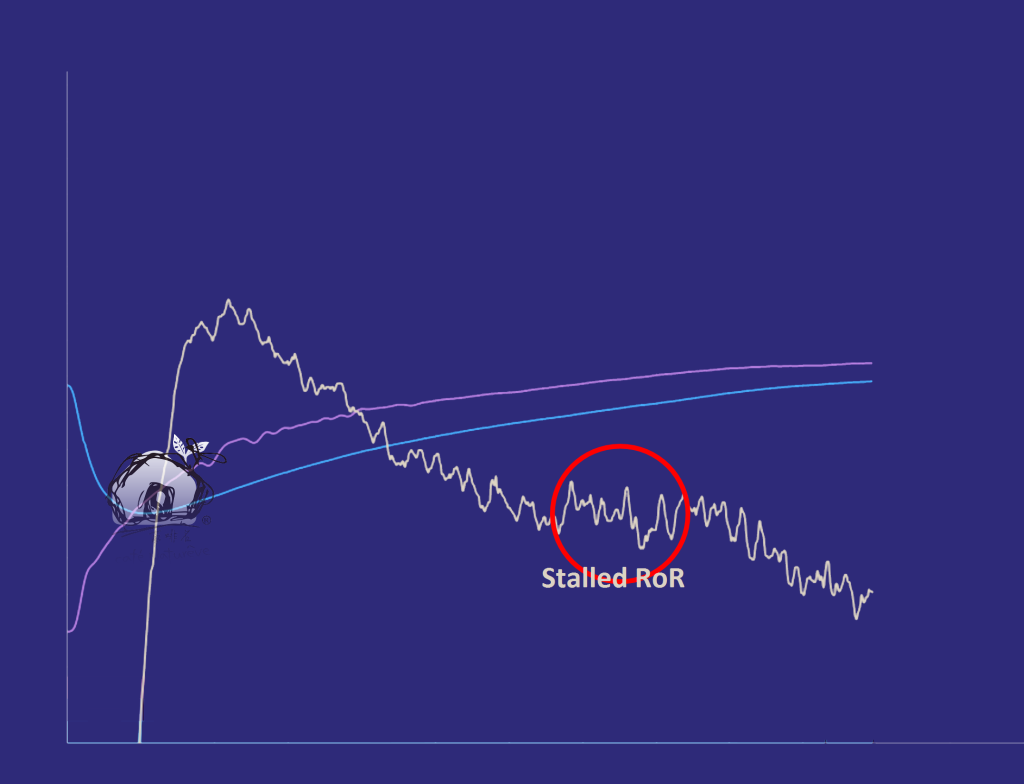
If the RoR does not flatten out, it suggests that more and more moisture is being released in succession. This is what I mean when I say that the “moisture chain” has not been broken. When the moisture chain remains unbroken, professionals often describe the roast as being “efficient” — though I find that term far too vague, and it often confuses learners even more. Compared with a stalled (flat) RoR, this usually means the roast can move forward more quickly.
When seeing a stalled RoR, it is very important to become aware of “which layer(s)” do not contribute to the moisture release.
Coffee flavors are generated by, or a gradient. This post explains this idea: Flavor Layering in Coffee.
Understanding stalled RoR is important because it directly affects flavor. See 1.3.5 RoR Shapes in the Aillio Bullet R1 / R2 for a more detailed explanation.
It also implies that when heat penetrates deeper into the bean, the outer layers still retain relatively more moisture and origin character, which is why the cup tastes more vivid and lively. It sounds simple, doesn’t it? However, this is something many roasters spend a lifetime trying to achieve.
There are many ways to make RoR decline gradually. So which approach is better, and more appropriate for the moment?
Member’s Section.
What RoR Actually Shows During a Roast
RoR Shows Thermal Momentum, Not Just Temperature Change
RoR records the TREND of how the beans are receiving heat. It also gives us clues about the movement and retention of moisture inside the coffee.
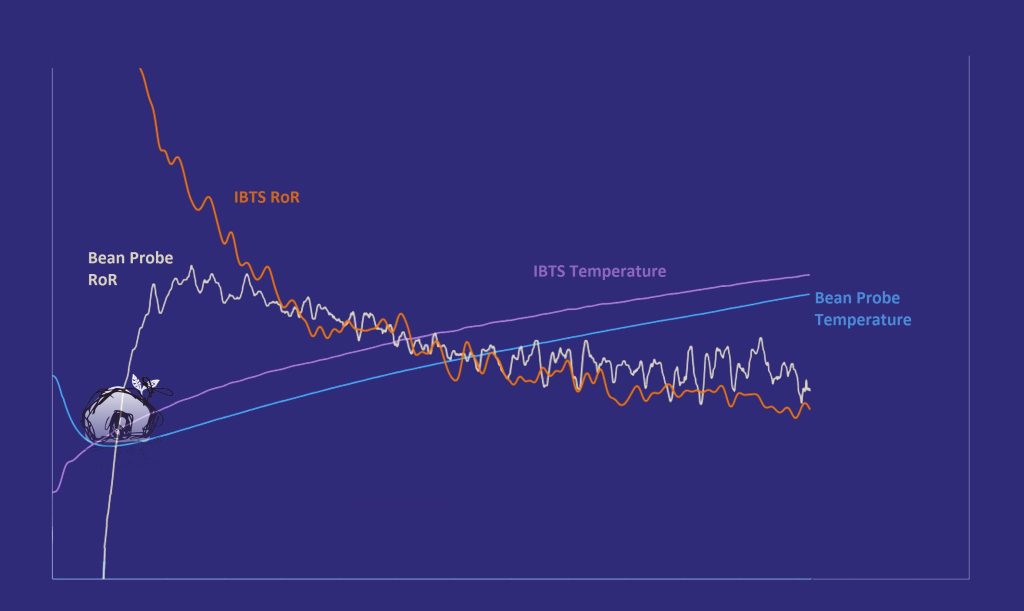
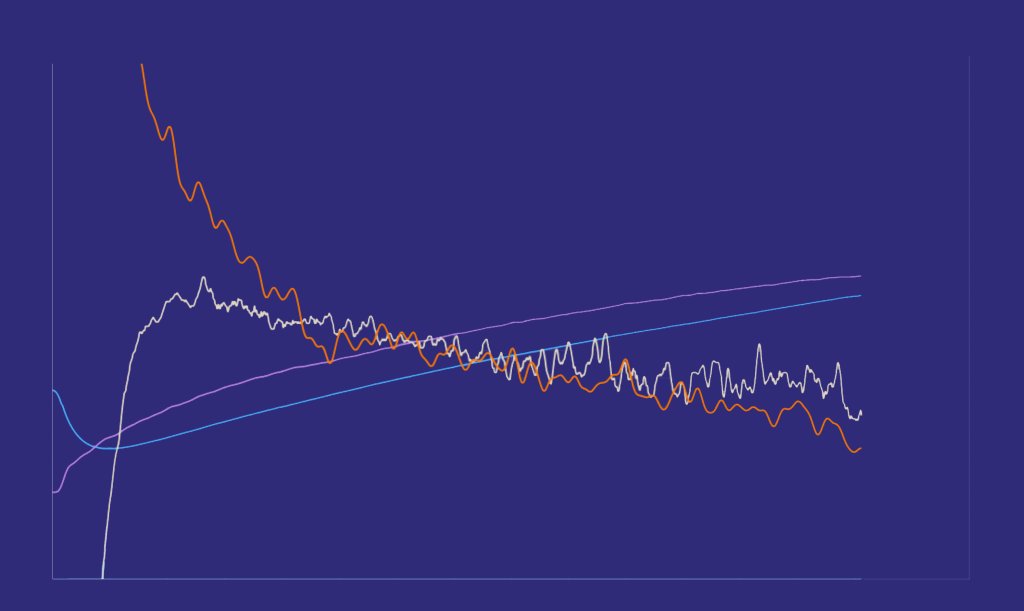
This is especially important on the Aillio Bullet R1 / R2, because the roaster provides both IBTS and bean probe data. The curve is not just a technical line on the screen. It is a record of how the coffee is reacting to heat, moisture movement, machine settings, and environmental conditions.
However, one thing must be understood clearly:
RoR does not represent the total amount of moisture activity inside the bean. It only records the TREND of moisture movement and retention.
Even when using the same coffee and the same batch size, roasting time can still change simply because the ambient conditions are different. This is why RoR should not be treated as an isolated number. It should be read together with the coffee itself, the machine, the batch size, the weather, and the actual cup result.
The decisions we make during roasting produce certain results, and those results are what make the roast take a shorter or longer amount of time.
Why Good-Looking RoR Should Not Always Be Read as a Perfect Profile
A Beautiful RoR Curve Does Not Always Mean a Better Cup
Many people ignore the actual nature of the coffee bean because they want to “design a recipe.” They begin by demanding fixed time targets for each roasting phase — drying, Maillard, and development — and then they start demanding certain RoR numbers as well.
The result is often that the beans end up either underheated or overheated.
Another common problem is that people become overly concerned about whether the RoR might crash or flick. In order to avoid those shapes, they force adjustments during the roast simply to make the curve look beautiful.
They believe that as long as a profile has no crash or flick, it must be a good roast.
But in reality, making a curve look beautiful is not difficult at all
You can set the PH very high, or very low, and then pair it with suitable parameters. The profile can still look clean and attractive. But a beautiful curve does not necessarily mean a delicious roast.
That is exactly the point. Whether the PH is very high or very low, the profile can still look beautiful if the supporting parameters are arranged properly. This is part of the dualities of coffee roasting.
The real priorities should be these:
Understand the coffee bean
Understand the principles of roasting
Understand the machine
Only then can we make the right decisions.
RoR and Scorching on the Aillio Bullet
Why Scorching Is Less Common on the Aillio Bullet
As for scorching, it is actually very difficult to scorch beans in an Aillio roaster. The machine’s heat energy is relatively gentle, so I do not think scorching should be the first thing Bullet users worry about in every roast.
My guess is that many people have been influenced by a common idea online: if the charge temperature — or PH, preheat — is too low, then the heat cannot properly “penetrate” the bean, and the bean’s aroma cannot be fully “activated.”
This idea often leads people to believe that higher PH is always better.
In my opinion, this is probably one of the reasons why the so-called Nordic roasting style has become so popular in recent years. It is often described very simply: high heat and high airflow. Everyone wants something very light and very juicy, but not enough people stop to consider three important questions:
Can the machine actually provide that much convection?
Is this bean capable of absorbing heat that quickly?
Do the on-site conditions allow the roast to move that fast?
Of course, if the PH can be set higher, we will usually try to set it higher. But the truth is that higher is not always better.
What matters is finding the right PH for each coffee and for each batch size.
Do not charge at the same temperature only according to the number of grams of coffee you roast.
RoR, Time, and Bean Characteristics
RoR Should Be Read And Understood Together With the Coffee, Batch Size, and Weather
RoR should not be separated from time, bean characteristics, and roasting decisions.
Many roasters try to assign fixed time targets to drying, Maillard, and development. They may also try to force the roast toward a certain RoR number at a certain moment.
But coffee beans do not all respond to heat in the same way
Different coffees absorb heat differently. Different batch sizes change how the bean probe behaves. Different weather conditions change how the roast moves. Even the same coffee can behave differently from one day to another.
This is why the goal should not be to force every roast into the same time structure or the same RoR shape. The goal is to understand what the coffee is doing and then make decisions based on that response.
RoR is useful because it helps us observe the direction of the roast. But it should not replace judgment.
A clean curve can be misleading. A strange-looking curve may still produce a good cup. The final question should always be: did the coffee receive heat in a way that matched its structure, moisture condition, and flavor potential?
How to Continue Learning RoR on the Aillio Bullet
This article only explains the basic meaning and direct effects of RoR. To understand RoR more completely on the Aillio Bullet R1 / R2, the next step is to study how RoR changes during the roast and how different RoR shapes should be interpreted.
Before attempting to refine your roasting, I recommend reading these two articles:
The first article explains how to read IBTS RoR and bean probe RoR together, why they do not always move in the same way, and how their interaction can reveal heat absorption, moisture release, roasting momentum, and what I call the moisture chain.
The second article focuses on practical curve interpretation, including RoR peaks, flicks, crashes, stalled RoR, and baked flavors.
Together, these articles form the foundation for understanding RoR on the Aillio Bullet.
How to Roast
Ready to Put These Ideas Into Practice?
Follow my step-by-step guide to roasting on the Aillio Bullet R1 / R2, from understanding your coffee to reading the roast profile and deciding when to end the roast.
You’re welcome to reference or build on the ideas in this article. If you do, please include a link to the original Café Naturêve article.
Aim to become one of the best roasters in your region
Our cooling tray helps serious Bullet users improve the final step of their roasting workflow: faster cooling, cleaner chaff control, and more consistent post-drop handling.