RoR shapes on the Aillio Bullet R1 / R2 can reveal how heat, moisture, and roasting momentum are moving through the coffee bean. A profile may look like it is only flicking, crashing, or becoming stalled, but behind each shape there is usually a deeper problem related to gain, loss, moisture release, and heat application.
In this article, I mainly discuss RoR shapes from the perspective of the bean probe, because the bean probe is still useful when observing the trend of moisture movement during roasting. By comparing low RoR peak profiles, high RoR peak profiles, flicks, crashes, and stalled RoR, we can better understand what may be happening inside the bean.
A declining RoR is usually the direction we want, but the shape itself is not enough. A beautiful curve does not always mean a better cup, and a bad-looking curve does not always tell us exactly how to fix the roast. To understand RoR shapes properly, we need to read them together with preheat temperature, heat application, airflow, roast level, processing method, and the final cup result.
Quick FAQ
What does a low or high RoR peak mean in coffee roasting?
A low RoR peak usually means less heat has accumulated on the bean surface at that moment, while a high RoR peak usually means more heat has accumulated on the bean surface. However, the RoR peak should not be judged alone. It should FIRST be read in relation to the nature of the bean, and then together with airflow, preheat temperature, batch size, drum speed, bean structure, and the final cup result.
Why does RoR flick, crash, or become stalled during roasting?
A simple way to understand flicks, crashes, and stalled RoR is this: within a certain period of time, the heat being applied is greater than what the bean can absorb. As explained in RoR in the Aillio Bullet R1 / R2: How to Read IBTS and Bean Probe, bean probe RoR can help reveal the amount and rhythm of moisture release. When moisture release becomes unstable, or when the moisture chain inside the bean is broken, the RoR curve may flick, crash, or become flat.
Does a stalled RoR always make coffee taste baked?
A stalled RoR often leads to dry, flat, less juicy, or less flavorful coffee, but it does not always taste bad immediately after roasting. Sometimes the coffee can taste good for a short time because the outer layers have been transformed strongly by heat. However, the shelf life is usually short, and the cup may lose flavor quickly as the roast rests.
mins
Reading Time
One roasting defect that is often overlooked is slow post-drop cooling. When coffee stays hot for too long after drop, the cup can taste baked, flat, or muted.
Our Aillio Bullet R1 / R2 cooling tray helps make this step cleaner, faster, and more stable.
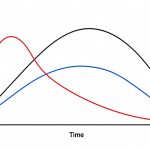
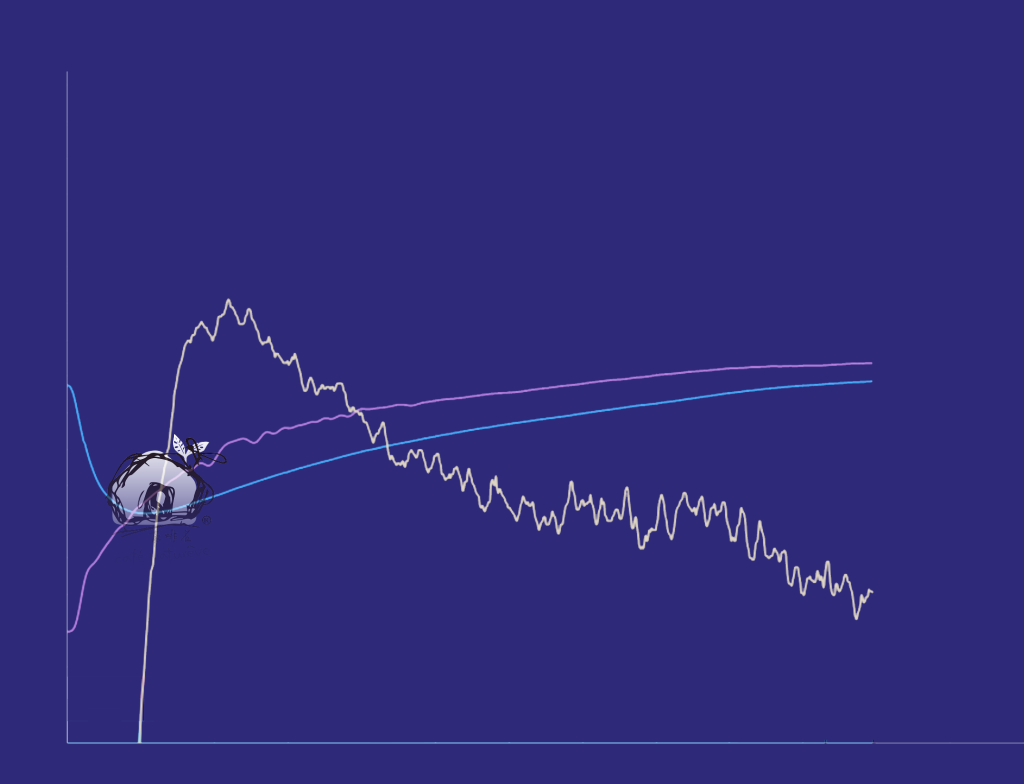
A high peak means that more heat has accumulated on the bean surface at that moment, while a low peak means that heat has not accumulated as much on the bean surface.
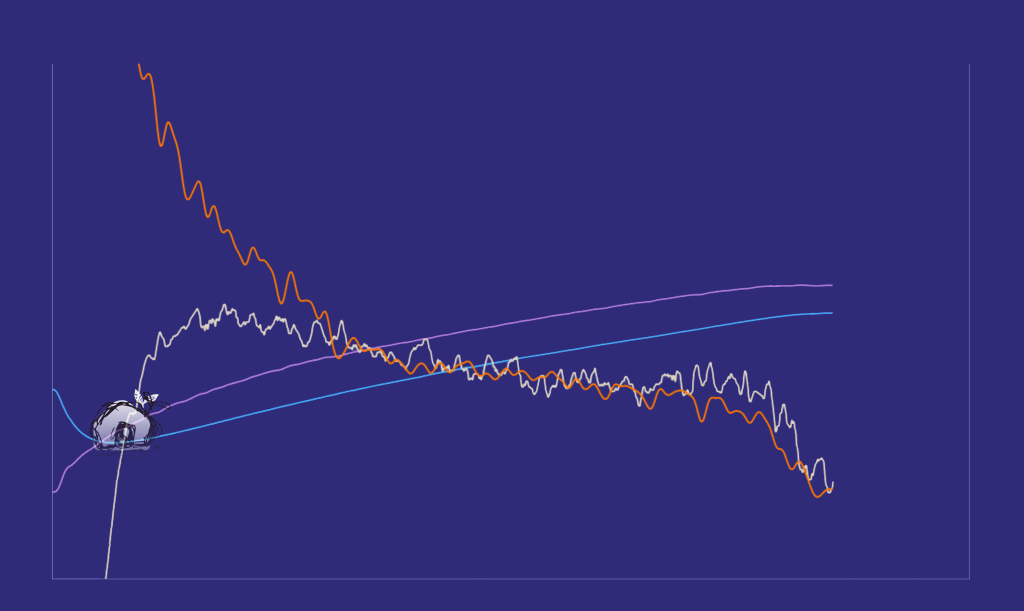
What a Low RoR Peak Means During Coffee Roasting
For a profile with a low RoR peak, less heat has accumulated on the bean surface. If the airflow is not very high, this usually means more heat is moving into the beans.
In this situation, gain happens more easily, so slightly higher heat can still work well. However, loss must also be increased during the roast to keep the roast balanced.
I used to think that this type of coffee should be roasted with a shorter total roast time, but later I realized that this is not always true. It still depends on the condition of the beans. Time is the result of the decisions we make during roasting; it is not the reason why the coffee tastes good.
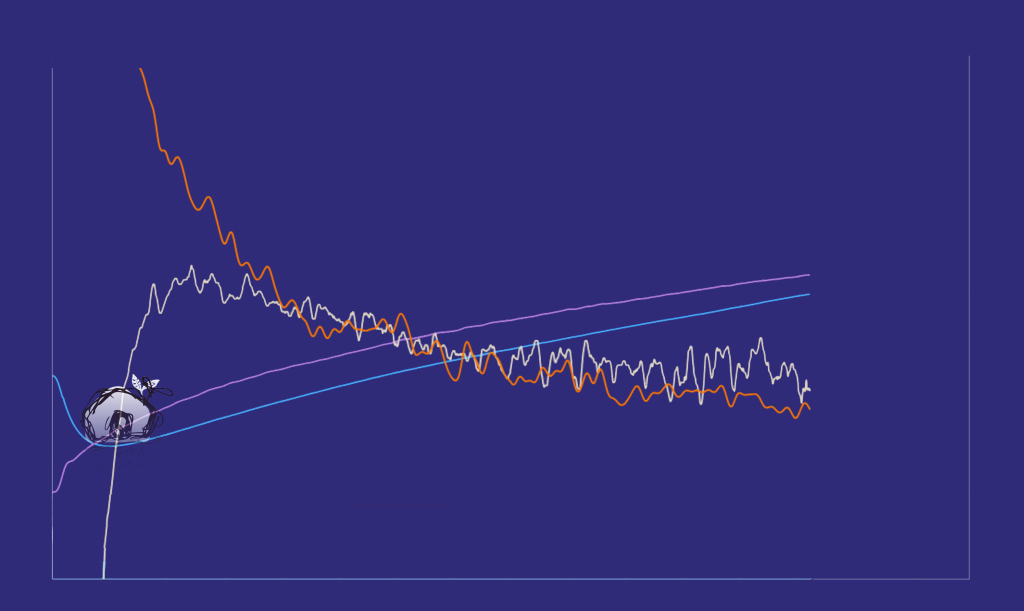
High RoR Peak Profile on the Aillio Bullet R1 / R2
Does a High RoR Peak Mean the Coffee Needs Gentler Heat?
For profiles with a high peak, more heat has accumulated on the bean surface. This implies that the beans are absorbing heat more slowly. As a result, many people would say that this type of coffee should be roasted with a “gentler” application of heat.
I always find it interesting when people use the word gentle in this context. Does gentle mean using a lower PH? Does it mean that, instead of planning to use P8, you should use P7? Or does it mean using more airflow?
No one has ever explained these things clearly and completely.
Both the initial heat application and the heat application during the roast can be described as gentle, but the true impact is NOT the same. Naturally, they will affect the beans differently, and the flavor will also be different. Every coffee has its own most suitable approach. In Chapter G. Roasting Has Started!, I will explain these differences in detail for different coffees.
Turning Point in Coffee Roasting: Is TP Important on the Aillio Bullet?
What Is the Turning Point in Coffee Roasting?
Some people may also call it the turnaround point. So, what is TP?
The Turning Point (TP) is the specific moment during a roast when the displayed bean temperature stops dropping and begins to rise.
To be honest, I rarely pay much attention to the TP value now. Although TP is not very helpful to me during roasting, the timing of TP can still give us a rough idea of whether the preheating was sufficient.
The following is Gemini AI’s explanation:
(Please do not fully adopt its opinion. I am only sharing some common views that are often seen online.)
Suggested time range: 1:00 to 1:30
Around 1:15: Many roasters regard this as the “sweet spot.” It suggests that the drum was sufficiently preheated and that heat transfer remained stable after charging.
Below 1:00: This may indicate that the preheat temperature was too high, or that the charge weight was too small. In that case, the bean temperature may rise too quickly in the early stage, causing the bean surface to scorch while the inner part of the bean is still underdeveloped.
Beyond 1:45: This may indicate insufficient preheating, or that heat was applied too late. It can prolong the overall roast time and may lead to flat flavors with weak acidity, often described as a baked flavor.
Reference for TP temperature Besides the timing, the temperature at TP is also often considered important.
It usually falls between 85°C and 100°C.
If your TP temperature is too low, for example below 80°C, then even if the timing reaches 1:30, the subsequent RoR (Rate of Rise) may still be difficult to build, causing the roast to feel weak and lacking momentum.
Why I Pay More Attention to Preheat Temperature Than TP?
My view is completely different. Rather than focusing on TP, I believe it is better to pay attention to the PH temperature, because the TP temperature itself is heavily influenced by PH.
The Preheat Temperature (PH) greatly affects the overall roast time. Under the same environmental conditions, different PH settings will significantly affect how the coffee beans receive heat in the early stage of roasting, and this will further influence the final roast result. In particular, the bean surface is exposed to heat from the very beginning of the roast, so the PH level has an especially strong effect on the condition of the bean surface.
Provided that the RoR does not crash, if our goal is to roast the coffee to a certain internal layer of the bean, then the PH will inevitably affect the final result.
The real difficulty is understanding what PH actually changes during roasting.
Preheat
sets the direction
How Preheat Temperature Shapes RoR Peak and Flavor Direction?
In other words, the PH has already largely determined the flavor of the batch. How to choose the PH depends, to a large extent, on whether the roast is heading toward a High RoR Peak Profile or a Low RoR Peak Profile, as mentioned above. But there are too many factors that can make a profile peak higher or lower, and in most cases the cause is a combination of factors. If you do not understand what is actually shaping that profile, then discussing the profile or the recipe is meaningless.
The turning point (TP) is not determined by PH alone. It is the result of the preheat together with all the other inputs applied during the first stage of roasting (0–1 min). In fact, these settings can be regarded as part of preheat in a broader sense.
Flick, crash, and baked profiles are probably the most frequently discussed undesired profiles in the roasting world. I know that many Bullet users look down on flick and crash, and some even make fun of Scott Rao’s declining RoR theory. But I support Scott Rao’s theory.
Why Does the Profile Flick, Crash, or Become Stalled (Baked)?
These three conditions often occur in sequence, and they are among the most common roasting problems.
What Is a Flick in Coffee Roasting?
A flick happens because moisture content escapes from the cells. As more moisture leaves the coffee bean, the bean probe detects more heat, causing the curve to appear to flick.
What Is a RoR Crash in Coffee Roasting?
If, at this point, heat is still able to continue conducting inward and keep driving moisture out from inside the bean, that moisture will carry heat away. In that case, the RoR can continue its declining trend and will not crash. However, if heat can no longer conduct inward at this stage, and moisture near the bean surface suddenly leaves in a large, clustered release, the curve will crash.
What Is a Stalled RoR or Baked Profile?
At that point, heat can only be conducted through the woody structure of the coffee bean and can no longer be carried by moisture. In other words, the roast is then becoming a relatively dry roast of the outer layers. This is what we call a baked profile, or a stalled RoR.
However, whether the RoR curve crashes depends on the balance between gain and loss. Gain refers to the gain of momentum, while loss refers to the loss of moisture content, which also implies a loss of heat. A roaster will likely encounter 4 situations. As discussed in more detail here: Pay Attention to RoR While Thinking About Gain And Loss so the RoR can decline along a stable slope.
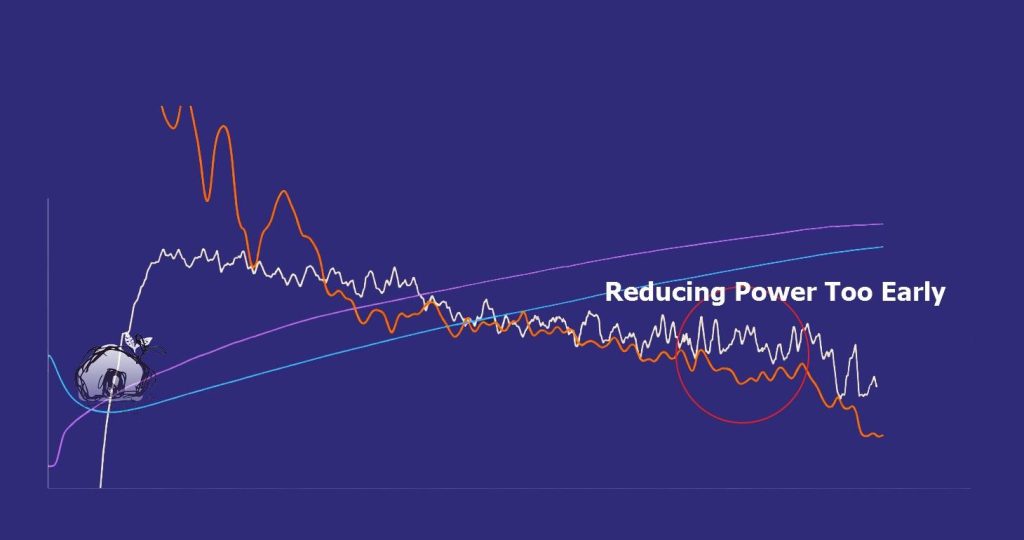
Another Common Cause of a Stalled RoR: Reducing Power Too Early
Reducing power too early is a common mistake among many Aillio Bullet R1 / R2 users
What “Too Early” Means
In this post Roast Defects On The Aillio Bullet R1 / R2, I explained the result of using Insufficient heat. It is mentioned: “When the overall heat energy is not enough to properly heat the total amount of beans in the drum, the flavor — the bean’s character — becomes unclear.”
Please note that I used the word “overall.” Overall can refer to two situations: the initial power setting being too low from the beginning, or reducing power within the first few minutes, in the middle of the roast, or even near the end of the roast (as long as it’s earlier than it should have been).
For most roasters, “the initial power setting being too low from the beginning” is slightly easier to understand, because in this situation, all variables — power, drum speed, and fan speed — are at least fixed and clear.
However, reducing power “within the first few minutes, in the middle of the roast, or even near the end of the roast” is much harder for most people to grasp, because everyone defines “earlier than it should have been” differently.
Why Early Power Reduction Is Risky
The reason is that the only active heat source in the Bullet R1 / R2 is the induction heating board underneath the drum. Unless it is necessary, you should not reduce power casually.
Many Bullet users imitate the heat-reduction habits used on semi-hot-air roasters or full hot-air roasters. They decrease power in the middle of the roast to create a continuously and steadily declining RoR curve.
The result, however, is often a sudden drop in RoR, followed by a stalled RoR.
Therefore, my suggestion is: do not reduce power casually.
As long as the overall decision has been planned before the roast, even if there are some small issues during the roast — usually slightly too much heat application — you do not need to decrease power. The RoR will naturally decline, and the coffee will taste good.
How RoR Responds to Early Power Reduction
Reducing power in advance is usually necessary on traditional electric-heating-element roasters, because traditional electric heating elements have a more obvious characteristic of thermal lag. When the operator lowers the heat, the electric heating element cannot cool down immediately, and its stored heat will continue to be released. Therefore, to avoid losing control and overheating in the later part of the roast, power usually needs to be reduced earlier during the roast.
However, the Aillio Bullet R1 / R2 uses induction heating. Every increase or decrease in power usually shows an immediate response on the RoR.
Very Early Reduction of Power
If you decrease power when you should not, the first thing you will see is a clear drop in RoR. After about one minute, the RoR will enter a stalled state.
This happens because the coffee beans do not have enough heat energy to push heat deeper into the beans. As a result, the deeper inner parts of the coffee bean are not properly heated. In other words, heat is less able to move deeper into the bean core, so the amount of vapor released is not enough to keep the whole RoR curve declining. This is why the RoR becomes stalled.
Another “Early” Reduction of Power Near The End
Moisture, Layer Color, and Flavor
Although doing this may preserve more moisture in the outer layers, the first crack temperature will be lower. If the DT time is not changed, the IBTS end temperature will also be lower. It may “look like” a very nice light roast, but it will usually taste weaker.
This is because the color gradient near the outer layers and close to the bean surface is smaller than originally planned. As a result, the cup will have lower liveliness and lower richness. Broadly speaking, stalled RoR means that certain layers do not contribute to moisture release.
How to Avoid Early Power Reduction
Remember this: before roasting, you must first have a rough roasting plan. This sentence should always be remembered: because there are too many variables, given the on-site variables, there is only one way to achieve a certain flavor, and “that way” is dynamic and always changing.
This is why I never advocate copying or overlaying profiles. Even for successful profiles I have roasted before, I do not recommend using copy or overlay to roast. If you are a serious roaster, you might understand this.
Overall variables include ambient temperature, humidity, air pressure, the condition of the green coffee, whether you have already roasted many batches continuously, and so on.
Among the many uncertain variables that need to work together, you must know which principles are fixed. For example, before every roast, I always decide the approximate level of airflow and power I will use for that roast, and then adjust the other parameters accordingly.
This is what the Member’s Section will teach you.
How A Stalled RoR Affects Flavor and Mouthfeel?
What does a flat (stalled) RoR taste like?
It tends to taste dry, lacking in spaciousness, not juicy, and lacking in flavor. Even worse, if the roast time of that batch is too short, the rawness inside the bean will not be sufficiently removed or transformed. In other words, too much moisture remains involved in the chemical reactions, which may lead to plant-like bitterness or astringency.
However, there are times when a batch with a stalled RoR tastes good immediately after roasting. But its shelf life is usually very short, lasting only about three days. The reason it can taste good temporarily is that the surface has been transformed very thoroughly by heat.
Why Stalled RoR Can Taste Good Immediately After Roasting?
Layers that have undergone a high degree of transformation often taste good at first, but their aroma compounds leave very quickly. After about a week, the coffee begins to lose flavor, because the outer part has already overmatured to the point of becoming flavorless, while the inner part has not yet matured. It is often not until the third or fourth week that the better flavors reappear.
When there is no gradient, and the coffee has not yet fully matured during the first week, extraction should be reduced during brewing. The brew ratio also needs to be lowered. For example, if you previously brewed at 1:15, you may now need to brew at around 1:13.5 to 1:14, because the amount of desirable substances is already too limited.
Therefore, stop believing that “it tastes bad only because it has not rested long enough.” Of course, the coffee may taste better with more resting time, but if the roast is successful, it should still taste fairly good right after roasting and during the resting process. If a fresh coffee tastes bad, that is the roaster’s problem.
If the gradient has been properly developed, even a light roast can taste good when made into latte.
Why Sudden Moisture Release Can Break the Moisture Chain?
When a large amount of moisture leaves the bean too suddenly, the moisture chain breaks. Maintaining the moisture chain is crucial during coffee roasting. For more on the moisture chain, please see 1.3.2 RoR Actually Reflects the State of the Moisture Chain.
In theory, if heat is applied properly, flick and crash should not happen. However, coffee beans are extremely sensitive to any momentum. Sometimes, roasting many batches in a row, or even a sudden rise in ambient temperature, can lead to different roasting results. Even highly skilled coffee consultants need to put in a great deal of effort during every roast to keep the curve from flicking or crashing.
Can a RoR Crash Be Rescued During Roasting?
Within a certain range, RoR can still be rescued. As for how to rescue it, and why moisture may suddenly leave in large amounts, I explain that in G. Roasting Has Started! (Of course, the best approach is to avoid flick and crash in the first place, and I also explain how to prevent them.)
When there is more convective heat during roasting, RoR is less likely to crash. This reminds me of coffee roasters that rely more on convection, such as Loring. There is a reason why Loring roasters are so expensive and why the coffee roasted on them often tastes so good.
Roast Level and RoR Crash on the Aillio Bullet R1 / R2
Why Light Roasts Are More Prone to RoR Crashes?
Light roasts are more prone to crashing. This is not because the roast level itself makes them more likely to crash, but because the parameter settings typically used for light roasts are more likely to lead to a crash.
Natural and Washed Coffees Crash at Different Stages
In addition, natural-processed coffees tend to crash during the roasting process, while washed coffees tend to crash after first crack. A crash after first crack in washed coffees usually does not have a major impact on flavor.
A crashy or stalled RoR makes the layering less distinct, and the whole bean tends to look darker overall.
Note: A darker color does not mean it will taste like a normal medium, medium-dark, or dark roast. Whenever a layer is affected by heat energy, its color will darken. What the roaster needs to examine is this: when heat travels through a given layer, how much moisture and how much terroir are still present in that layer?
Whenever a flick, crash, or baked curve occurs, you should immediately become aware of the following:
Which layer has the heat reached now? Is this layer receiving relatively higher or lower momentum now? Which layer has lost too much moisture? Which layer has received too much heat?
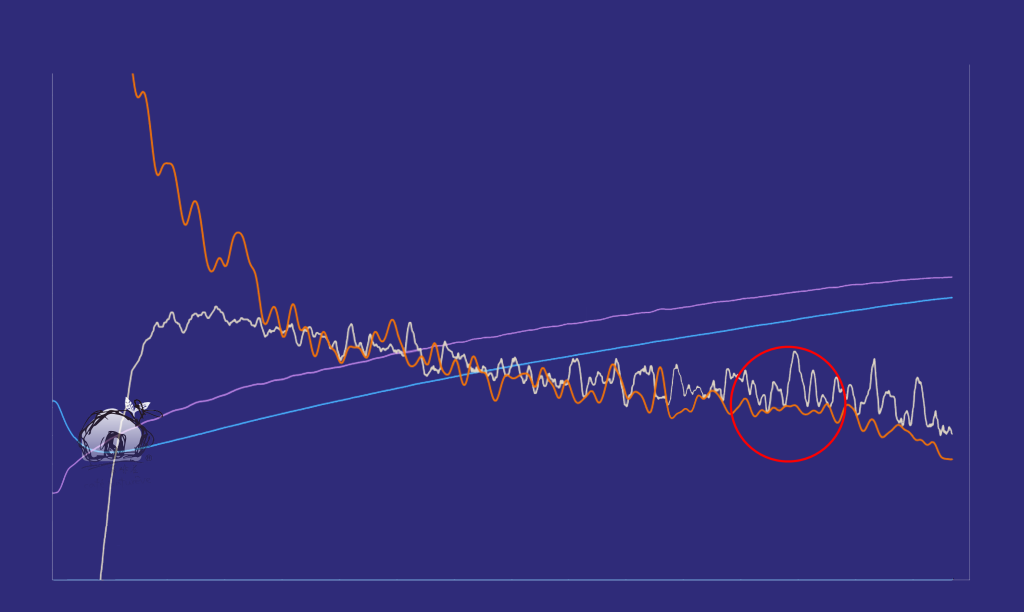
Question: In the profile listed below (a natural bean from Panama), there is a short period with a stalled RoR (baked). Do you know what should be done to correct it?
Answer: From this profile alone, even a highly skilled coffee consultant would not know how to adjust it.
In fact, there are many possible causes of baked coffee. Without a certain level of understanding of the coffee bean itself AND of roasting fundamentals (first principles), it is difficult to know how to correct it. In G. Roasting Has Started!, I explain clearly how to adjust your roast properly.
Roast Defects Caused by Flick, Crash, and Stalled RoR
The reason flick, crash, and stalling are discussed so often is that once these conditions occur, they usually lead to very obvious roasting defects.
The main defect they cause is the one described in 1.6.1 Vegetal (Green) Bitterness. This chapter is very important, and I strongly recommend that everyone read it.
Follow my step-by-step guide to roasting on the Aillio Bullet R1 / R2, from understanding your coffee to reading the roast profile and deciding when to end the roast.
You’re welcome to reference or build on the ideas in this article. If you do, please include a link to the original Café Naturêve article.
Save Time After Every Batch
A faster and cleaner cooling workflow means less time spent managing the final step of roasting and more time for cupping, profile development, packaging, marketing, and growing your coffee business.