This article introduces the three main heat-transfer methods in coffee roasting: conduction, convection, and radiation. It also explains how these concepts should be understood from the perspective of the Aillio Bullet R1 / R2. To make the ideas easier to follow, I will also briefly mention how other types of roasters apply heat, so we can compare the differences between different roasting systems.
However, the main focus of this article will still be the Aillio Bullet. Different roasters have different designs, heat sources, drum structures, and operating logic. Without long-term use, it is difficult to make a truly fair and accurate judgment about a machine. For that reason, I will only discuss other roasters in a conservative way and avoid making overly strong claims about systems I have not used extensively.
I started roasting with the Aillio Bullet R1 in 2017, and my machine has now officially become an R2. Café Naturêve has also been operating as a physical café for five to six years (2026). During this time, I have exchanged ideas with Bullet users and roasters from many different countries, including Blake from Arkansas. I have tested countless failed roast curves and brewed thousands of cups of coffee. These experiences do not represent every roasting system, but for Aillio Bullet R1 / R2 users, I believe there are many observations worth sharing.
Before discussing heat transfer on the Aillio Bullet R1 / R2, let us briefly review the three ways heat reaches coffee beans: conduction, convection, and radiation. These concepts are already common in general roasting articles, so I will keep the explanations short. The main focus will be on how these heat-transfer methods exist inside the roasting environment, how they heat coffee beans, and how they interact with other variables.
mins
Reading Time
Quick FAQ
Why is convection on the Aillio Bullet different from convection on hot-air roasters?
On the Bullet, heat is mainly generated by the induction heating modules, while airflow is drawn from the surrounding environment. Many Bullet users believe that the air entering the Bullet is, to some extent, influenced by the induction heating system. Because the incoming air is closely tied to ambient conditions, changes in room temperature, humidity, and season can directly affect how convection behaves inside the Bullet. This is why roasting on the Aillio Bullet R1 / R2 often requires adjustments as the weather changes. (Member’s Section)
Is a hot-air roaster always better than a conduction-based roaster?
Not necessarily. Hot-air roasters can heat coffee beans faster and produce very clean cups, but faster heat transfer does not automatically mean better roasting. Each roaster has its own heat-transfer logic, and the key is understanding how that machine controls gain, loss, moisture movement, and flavor development.
Why can’t roast profiles be copied across different roasters?
Roast profiles cannot be copied directly across different roasters because each machine transfers heat differently. Drying time, Maillard time, development time, first crack timing, RoR behavior, and probe readings can all change depending on the roaster’s design, heat source, airflow, drum structure, and sensor placement.
Heat control does not end at drop. Fast, even cooling helps protect the final quality of the roast and make the whole workflow much smoother.
Our Aillio Bullet R1 / R2 cooling tray helps make this step cleaner, faster, and more stable.
Conduction occurs when heat is transferred through direct contact. In coffee roasting, this happens when coffee beans touch the hot drum surface or other heated beans. Because conduction depends on contact points, it can heat certain parts of the bean surface more directly than others.
Conduction is a normal part of drum roasting, and it is not automatically a problem. However, when contact heat becomes too dominant, the outer layers of the bean may respond faster than the inner layers. This can lead to a heavier cup, less flavor transparency, or, in more serious cases, surface-related roast defects.
Convection Heat: Heat Carried by Moving Air
Convection occurs when heat is carried by hot air moving around the coffee beans. Compared with conduction, convection can reach the bean surface more broadly, including the uneven areas, cracks, and small surface structures of the coffee.
In practice, convection affects how quickly the bean surface dries, how moisture leaves the coffee, and how clean or transparent the final cup may feel. More convection does not always mean a better roast, but a well-managed convective effect often helps the coffee develop with better clarity and less heaviness.
Radiation Heat: Heat Emitted from the Roaster Body
Radiation occurs when heat is emitted from hot surfaces, such as the heated drum, inner walls, or roaster body. Unlike conduction, it does not require direct contact. Unlike convection, it does not rely only on moving air.
In coffee roasting, radiant heat contributes to the total energy received by the beans, especially when the roaster body is fully heated or during back-to-back (continuous) roasting. It may help the coffee absorb heat more quickly, but it should not be treated as a guarantee of even development. The final result still depends on total heat input, time, moisture movement, and how heat is distributed throughout the roast.
This becomes especially noticeable during back-to-back roasting. Some Aillio Bullet users have reported in Roast.World that the second batch progresses faster even when using the same coffee, batch size, preheat temperature, and roast settings. One likely explanation is that the drum, faceplate, and other parts of the roaster retain more energy after the first batch.
However, later batches do not always run faster; excessive cooling between batches can also leave the roaster with less usable thermal energy. This is why the displayed preheat temperature alone may not fully represent the thermal state of the entire machine.
To avoid excessive radiation heat from the roaster, whenever I roast, I set the preheat temperature (PH) 10°C lower than my target PH for the next batch. In the meanwhile, I prepare for the next batch. Then I do not re-preheat to the target PH until I am ready for the next batch.
Why Roast Profiles Cannot Be Copied Across Different Roasters
Because every roaster has a different main heat source, each machine heats coffee beans in a different way.
So how can we use different roasters properly? First, we need to identify the main heat-transfer form of the roaster we are using. That main heat source must be the foundation, while the other heat-transfer methods assist it.
Almost every roaster has conduction, convection, and radiation at the same time; the difference is the ratio between them.
Almost every roaster has conduction, convection, and radiation at the same time; the difference is the ratio between them.
What we need to do is understand the strengths and weaknesses of the roaster’s main heat source, how quickly it heats the coffee, how over-heating or under-heating appears, and then adjust the input of the main heat source. As long as the input of the main heat source is correct, the roast result usually will not be too bad.
In addition, every roaster has a different bean probe thickness and probe placement, and these differences affect the data being recorded. Scott Rao has written about this issue in “Your Bean Probe Has Been Lying to You,” where he explains why bean temperature data must be interpreted carefully.
Therefore, roast profiles from different roasters cannot be shared directly. When roasting on different machines, drying time, Maillard time, development time, and total roast time can all be completely different.
I still remember when I first bought the Bullet R1. I paid quite a bit of money to take a roasting class from the Taiwanese distributor at the time. In the class, the instructor told us that a “standard roast” must reach first crack at around the ninth minute, plus or minus ten seconds. That statement was seriously misleading for students.
Fortunately, I have gone through the long process of exploring roasting on my own. Wanting to get closer to “truth” and “reality” has been a major motivation that supported me along the way, and it is also one of the main reasons I built this website. I hope that after reading my articles, you will gain something valuable and avoid many unnecessary detours.
Why Convection on the Aillio Bullet Is Different from Hot-Air Roasters
The air entering the Aillio Bullet R1 / R2 is not heated by a flame or another external heat source before it enters the drum. Some people may say that the air passes over the induction heating board, but compared with a flame, this kind of heat source has lower momentum.
Generally speaking, if a machine can be called a hot-air roaster, the air is usually heated before it enters the drum.
The Bullet roaster is often criticized for not producing sufficient convection heat; however, I actually see that as an advantage. With fewer factors to consider, roasting becomes relatively easier.
Of course, different ambient temperatures imply different convection. But if the air is further heated before entering the drum, the situation becomes even more complex. That is why we say the Aillio is a very user-friendly roaster: because you only have to, or are allowed to, control three things: power, fan airflow, and drum speed.
Generally speaking, higher ambient temperature means there is more convection throughout the whole roasting process. But high convection is not only about hotter air. It is the combined result of three things:
the temperature of the ambient air
how much the beans are surrounded by air
the total amount of time the beans are exposed to hot air
Most people’s question is usually about the relationship between fan, airflow, and convection heat. Some well-known coffee consultants have also released practical paid content about airflow. Airflow certainly affects convection heat, and it has to be used properly. Using airflow is a trade-off: too much or too little can both cause problems. Airflow changes depending on the situation. It is dynamic.
The detailed adjustment methods will be explained in the Member’s Section.
If convection is used properly, the moisture chain is less likely to break. The RoR curve will be smoother, the overall roast time can be shortened, weight loss can be significantly reduced, and the coffee can become juicier, fuller in flavor, and very clean at the same time.
I first introduced the idea of the moisture chain in this article: RoR in the Aillio Bullet R1 / R2: How to Read IBTS and Bean Probe Coffee roasting is, in many ways, the process of controlling the moisture chain from the outer layers of the bean toward the inside. In that article, you can learn how the moisture chain works and how it responds during roasting.
With that concept in mind, we can now look at another common question: whether hot-air roasters are truly better than conduction-based roasters.
Are Hot-Air Roasters Better Than Conduction-Based Roasters?
Not necessarily. Hot-air roasters can heat coffee beans faster and can produce very clean, expressive cups, but faster heat transfer does not automatically mean the roaster is better.
Conduction-based roasters usually heat coffee beans more slowly. Many people dream of owning a full hot-air roaster because they believe hot-air machines are easier to control. Indeed, many famous hot-air roasters, such as Loring and IMF, can roast extremely delicious coffee. However, they are also very expensive. The Nordic-style roasting approach that became popular a few years ago is also easier to produce on hot-air machines. Because of this, some people may think that conduction-based coffee roasters are lower-grade machines.
However, because hot-air roasters mainly rely on high-temperature, high-volume, high-speed hot air to transfer heat, their heat-transfer efficiency is extremely high and their response is fast. If they are not controlled properly, hot-air roasters can also create roast defects such as tipping and scorching. In contrast, since I started roasting with the Bullet R1 / R2 in 2017, I have almost never roasted beans with tipping or scorching.
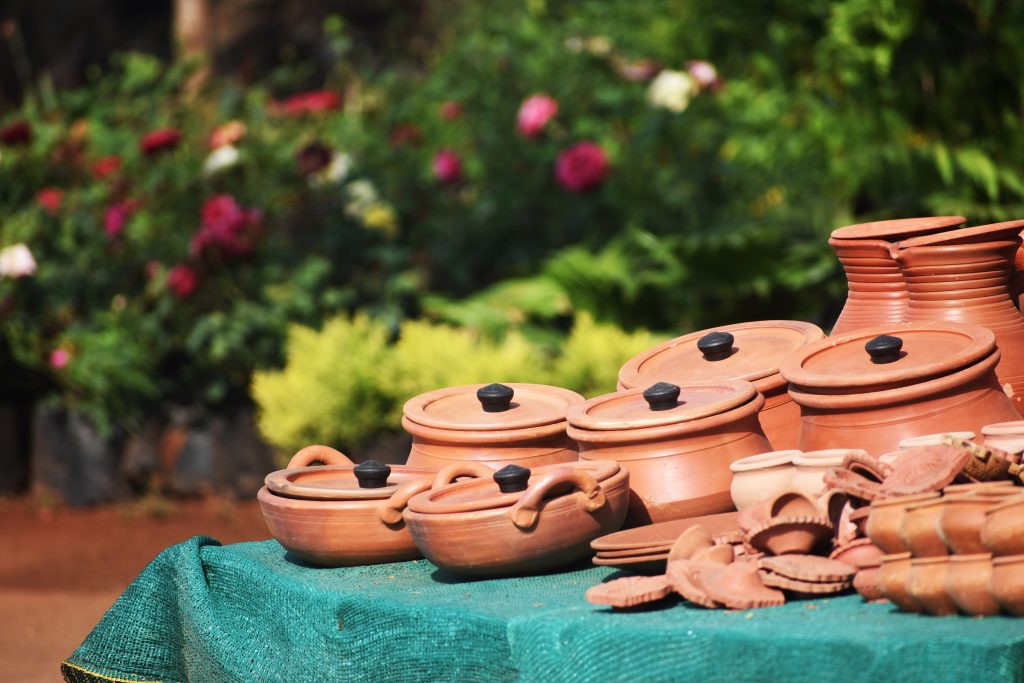
The most classic conduction-based roasting method is clay pot roasting.
In Taiwan, many people roast coffee by hand in clay pots and rely on sensory judgment to read the state of the beans. Personally, I think it is almost impossible to control flavor precisely this way. There are also many automated clay-pot roasting machines on the market, and some of them have thermometers installed. However, even with a thermometer, they are still semi-open roasting systems and are affected by the environment more than ordinary roasters.
We need to understand that roasting is essentially about precisely controlling gain and loss. If a roaster is a semi-open system, I believe it is difficult to control gain and loss.
I believe that coffees from certain origins, or coffees with certain characteristics, are extremely difficult to roast well in a clay pot. A café owner who uses a clay pot roaster once visited my café. We are friends. He specifically asked me whether I had beans from a certain origin. At that moment, it seemed to confirm this idea.
Relevant details will be explained in the Member’s Section.
Therefore, I believe clay-pot roasting has many operational limitations. The Aillio Bullet and clay-pot roasting are both conduction-based in some sense, but the Aillio Bullet clearly offers much better controllability.
Rather than arguing which roaster design wins, I think it is more important to understand the nature of each system. Every coffee has its own natural heat-conducting behavior, and different environmental conditions also supply different amounts of energy to the coffee beans. We must respond to these conditions with different adjustments. This is how we can still roast good coffee when the weather changes or when the green coffee behaves differently.
Convection vs Conduction Heat: A Simple Hand-Dryer Example
For beginners, it might be hard to imagine the difference between convection and conduction heat. Here is a common example from daily life: after washing your hands, you want to dry them. Would you use a towel or a hand dryer? Which one dries your hands faster?
Of course, it is the hand dryer, because air reaches every nook and cranny between the fingers and palms. The spaces between your fingers are just like the pores or uneven surfaces of a coffee bean. With more convection heat, coffee beans naturally heat up faster.
You can also understand the difference academically: conduction heat affects the beans only when part of the bean is in contact with the drum or with surrounding beans, while convection heat affects the beans continuously as long as the drum is not a vacuum. Therefore, if possible, rely on convection heat as much as you can, not only because it is more efficient, but also because the flavor profile is cleaner.
Does a Radiant-Heat Roaster Guarantee Faster Bean-Core Development?
Not necessarily.
Some near-infrared coffee roasters on the market emphasize claims such as “heating the bean core and bean surface as simultaneously as possible.” I used to believe this kind of statement as well. However, as my roasting experience accumulated, I began to feel that this wording can be misleading. It can make people think that heat energy can bypass the bean surface and directly heat the bean core, as if the core and the surface could truly be heated at the same time.
A more accurate way to describe it would be this: near-infrared energy may allow part of the energy to pass through the bean surface and be absorbed below the surface layer, thereby reducing the heat-transfer gap between the surface and the inner layers.
However, this does not mean the bean core and bean surface are heated simultaneously.
Radiant Heat
Does
Not
Heat
Surface and Core
Together
Coffee beans are not transparent media, and radiant energy is not distributed evenly throughout the entire bean. The phrase “heating the bean core and surface as simultaneously as possible” is closer to marketing language than a strict heat-transfer description.
The characteristic of radiant heat is that it does not need air or metal contact to transfer energy. Convection heating relies on hot-air movement, where the air contacts the bean surface and transfers heat to the coffee. Conduction heating relies on a boiler, drum, or contact surface to transfer heat to the coffee.
In comparison, radiant heat can act on coffee beans more directly. With a good heat-source design and proper agitation, coffee beans may also be exposed to radiant heat more evenly. At the same time, some radiant energy may pass through the bean surface and be absorbed at a deeper position.
However, higher heat efficiency does not guarantee a better roast. When heat enters the bean very quickly, but moisture migration and moisture exhaust do not keep up, the development between the inside and outside of the bean may still become unbalanced.
Especially before the bean structure has softened enough, internal moisture may begin to turn into vapor, but it may not be able to leave the cells and pores smoothly. This can increase internal pressure inside the bean and may also trap moisture inside the coffee, making later-stage development less clean. In some cases, this can create grassy or vegetable-like notes, or the roast defect I call vegetal bitterness.
Vegetal bitterness often appears when chemical reactions progress before the coffee has released enough moisture.
In reality, every heat source is a double-edged sword. The more efficient a heating method is in one area, the more we need to understand the risks it may bring.
I once tasted serious vegetal bitterness at a well-known café in southern Taiwan that used a near-infrared roaster. However, I would not say that a certain type of roaster is necessarily bad because of that. Every roaster has the potential to roast satisfying coffee, as long as we understand the nature of the heat source instead of only believing marketing language.
In the same way, even though the Aillio Bullet does not have truly heated hot air, it can still roast excellent coffee beans if we understand its heat-energy characteristics.
Can You Taste the Roasting System? Can Different Roasters Really Produce the Same Flavor?
The project “Can You Taste the Roasting System?” is very inspiring because it reminds us not to oversimplify cup flavor into the brand of the roaster or the type of heat source. In that project, Anne Cooper and Rob Hoos attempted to match yellowing, first crack, development time ratio, final whole-bean color, and ground color on three machines: the Probat UG15, Loring S35, and Diedrich IR-5. Then they used triangle cupping to test whether the roasting system could be tasted.
However, I think this project also needs to be understood within its assumptions. Although the three machines had different heat-transfer ratios, all of them involved hot air in the roasting process. Because they shared hot air as a common foundation, the roasters could use heat, airflow, and pacing to guide the coffee beans into yellowing, first crack, and drop at similar time points, and finally produce similar whole-bean color and ground color. Under those conditions, it is understandable that the cup flavors became closer.
However, this does not mean all roasting systems can be understood using the same framework. Machines such as the Aillio Bullet do have airflow, and convection heat transfer certainly exists. However, the Bullet does not use heated hot air as the main heat source entering the bean mass in the same way as a traditional gas drum roaster or a Loring. Therefore, the Bullet’s heat-energy path, moisture-release rhythm, RoR response, and internal bean development all need to be understood separately.
This is why I believe understanding the first principles behind roasting is more important than memorizing the fixed operation of any specific machine.
First Principles
Matter
More
Than
Machine
Settings
What roasters truly need to master is not just the terms convection, conduction, and radiation, but the gain and loss each heat source brings: what advantages it offers, and what risks it creates at the same time.
When we understand these deeper principles, we are less likely to be led by machine brands, marketing language, or beautiful curves. Different roasters certainly have different personalities, but every machine is still governed by the same natural laws. Understanding the nature of all things is what allows us to respond to different heat sources, different beans, different weather, and different roasters. This is the ability that roasting truly requires.